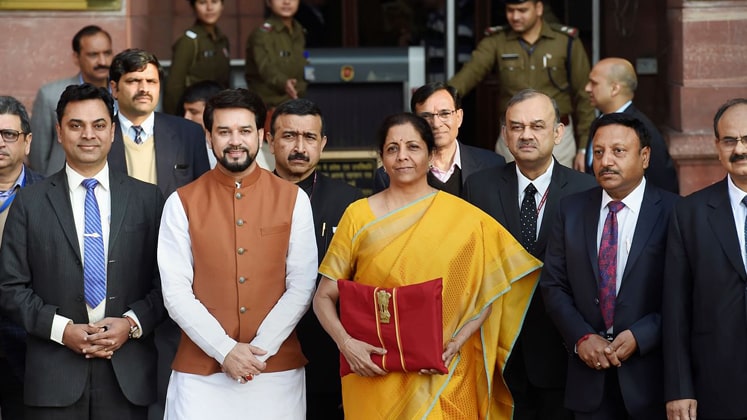
Union Finance Minister Nirmala Sitharaman tabled the Union Budget 2020-21 in the Lok Sabha today. The minister insisted that the Budget will boost income and purchasing power.
Given below are some of the important points of the Budget regarding textile and apparel industry.
Textiles
India imports significant quantity of Technical Textiles worth US $ 16 billion every year. To reverse this trend and to position India as a global leader in Technical Textiles, A National Technical Textiles Mission will be introduced, with a four-year implementation period, at an estimated outlay of Rs. 1,480 crore.
Anti-dumping duty on purified terephthalic acid (PTA) is being abolished. Notably, PTA, for example, is a critical input for textile fibres and yarns.
The Ministry of Textiles has been allocated Rs. 3,514.79 crore in the current Budget against the allocation of Rs. 4,831.48 crore in the 2019-20 Budget.
For ATUF Scheme, the fund allocation is only Rs. 761.90 crore.
Applicable for all
In the coming months, the Government shall review Rules of Origin requirements, particularly for certain sensitive items, so as to ensure that FTAs are aligned with the conscious direction of Government policy. It has been observed that imports under Free Trade Agreements (FTAs) are on the rise. Undue claims of FTA benefits have posed threat to domestic industry and such imports require stringent checks. This will help reduce imports from Bangladesh, etc. that is plaguing textile industry.
The Government proposes amendments in Companies Act to decriminalise civil offences.
Tax payer charter will be part of statute. Around 70 of more than 100 income tax deductions and exemptions have been removed, in order to simplify tax system and lower tax rates. The Budget has also proposed ‘Vivad se Vishwas’ scheme for direct tax payers whose appeals are pending at various forums. The tax on cooperative societies has been proposed to be reduced to 22 per cent plus surcharge and cess, as against 30 per cent at present.
Besides, Rs. 3,000 crore proposed to provide for skill development.
For exporters
Digital refund of duties and taxes of centre, states and local bodies to exporters from this year.
Nirvik (Niryat Rin Vikas Yojana) scheme to provide enhanced insurance cover and reduce premium for small exporters.
MSME
The Budget proposed to raise by 5 times the turnover threshold for audit from the existing Rs. 1 crore to Rs. 5 crore. Further, in order to boost less cash economy, it is proposed that the increased limit shall apply only to those businesses which carry out less than 5 per cent of their business transactions in cash. As of now, businesses having turnover of more than Rs. 1 crore are required to get their books of accounts audited by an accountant.
A scheme to provide subordinate debt for entrepreneurs of MSMEs will also be introduced. The Government has also asked RBI to extend debt restructuring window for MSME by a year to 31 March 2021.
An app-based invoice financing loans product will be launched. This will obviate the problem of delayed payments and consequential cash flows mismatches for the MSMEs.
Start-ups
The Government proposes to provide early life funding, including a seed fund to support ideation and development of early stage start-ups.
The Budget proposes deferment of tax payment by employees on ESOPs (employee stock ownership plan) from start-ups by 5 years or till they leave the company or when they sell their shares, whichever is earliest.
An eligible start-up, having turnover up to Rs. 25 crore, is allowed deduction of 100 per cent of its profits for 3 consecutive assessment years out of 7 years if the total turnover does not exceed Rs. 25 crore.
In order to extend this benefit to larger start-ups, there’s a proposal to increase the turnover limit from existing Rs. 25 crore to Rs. 100 crore.
Moreover, considering the fact that in the initial years, a start-up may not have adequate profit to avail this deduction, the Government proposes to extend the period of eligibility for claim of deduction from the existing 7 years to 10 years.
For Public Ltd. Companies
Dividend distribution tax (DDT) to be removed (currently it is 15 per cent). Dividend shall be taxed at the hands of the recipients.
Logistics
Rs. 1.7 lakh crore provided for transport infrastructure in 2020-21.
Sustainability
India’s commitment towards tackling climate change made in Paris conference kick starts from 1 January 2021.
Various textile and apparel hubs get benefit
Bengaluru: The Government will also provide 20 per cent equity for Bengaluru suburban transportation project, which is worth Rs. 18,600 crore.
Delhi: Rs. 4,400 crore solution to control Delhi’s pollution.