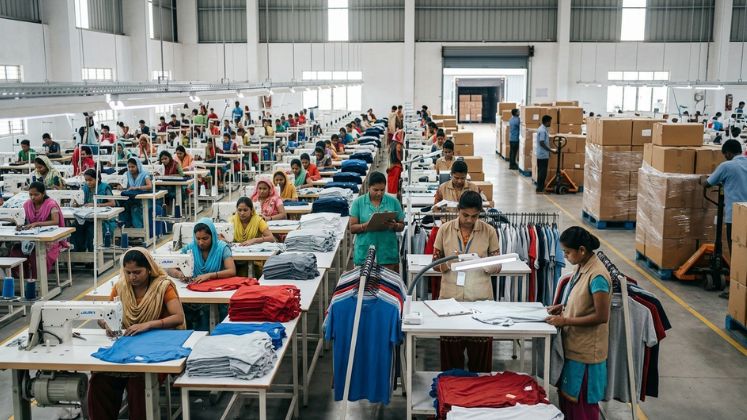
India’s T-shirt exports accounted for nearly 40% of the country’s total knitwear shipments in FY ’25, highlighting the category’s continued dominance despite challenging global market conditions.
India’s overall knitwear exports were valued at approximately Rs. 37,300 crore (US $3.73 billion) during the financial year, while T-shirt exports alone exceeded Rs. 20,000 crore (US $2 billion). The figures underline the significance of the segment within the country’s apparel export basket.
Product-wise export values during FY ’25 included children’s wear at Rs. 6,696 crore (US $669.6 million), nightwear and pyjamas at Rs. 2,727 crore (US $272.7 million), shirts at Rs. 2,718 crore (US $271.8 million), cotton yarn blended jersey garments at Rs. 2,077 crore (US $207.7 million), and cotton nightwear at Rs. 1,917 crore (US $191.7 million).
Within the T-shirt category, cotton T-shirts led exports with shipments worth Rs. 15,975 crore (US $1,597.5 million), followed by non-cotton T-shirts at Rs. 3,933 crore (US $393.3 million) and synthetic fibre T-shirts at Rs. 1,296 crore (US $129.6 million).
According to Prabhu Dhamodharan, Convener of the Indian Texpreneurs Federation, India exported close to 100 crore units of T-shirts during the last financial year. He stated that T-shirts and children’s wear together contributed around 40% of the country’s total knitwear exports.
Dhamodharan noted that duty-free trade agreements could increase exports of these categories by around 10% in the first year after implementation. However, he pointed out that average export realisation for such products remained relatively low and emphasised the need for a stronger focus on value-added garment manufacturing to improve export earnings.
He further observed that enquiries from the UK market for new varieties of value-added apparel had risen following the announcement of the India-UK trade agreement. According to Dhamodharan, the development has increased the urgency for Indian manufacturers to expand their capabilities in producing higher-value garments and respond more effectively to emerging fashion trends.





 Bharat Tex Special Report 2026