Apart from two major landmark initiatives Mega Integrated Textile Region and Apparel (MITRA) Parks and Production Link Incentive (PLI), in the last few months, the Union Ministry of Textiles has also taken some more steps which will have a long-term impact and should benefit the industry in a good way. These initiatives are the coverage of the entire supply chaina and not just of one particular segment like extending RoSCTL scheme up to 21st March 2024 for garment and made-ups sectors; announcing WTO compatible RoDTEP rates for yarn, fabric, and handicrafts; removal of anti-dumping duty (ADD) on Viscose Staple Fibre (VSF)… Adding more value and creating more opportunities for its textile industry, Tamil Nadu is also following similar steps in terms of industry-friendly policies and initiatives aligning with the measures being taken up by the Central Government. It will now be interesting to see how the combination of beneficial policies of both Central and State Governments will help Tamil Nadu grow fast.
Tamil Nadu’s textile industry has a very important place in India. Having clusters like Coimbatore, Tirupur, Chennai, Karur, Salem, Erode and Dindigul, the state accounts for 19 per cent of India’s textile output. It has around 46 per cent of spinning, 60 per cent of yarn export, 20 per cent of powerloom capacity, 70 per cent of cotton fabric knitting, 20 per cent TUFs investments, providing direct employment to around 31 lakh people and contributing more than Rs. 50,000 crore to exports and to one-third of textile business in the country.
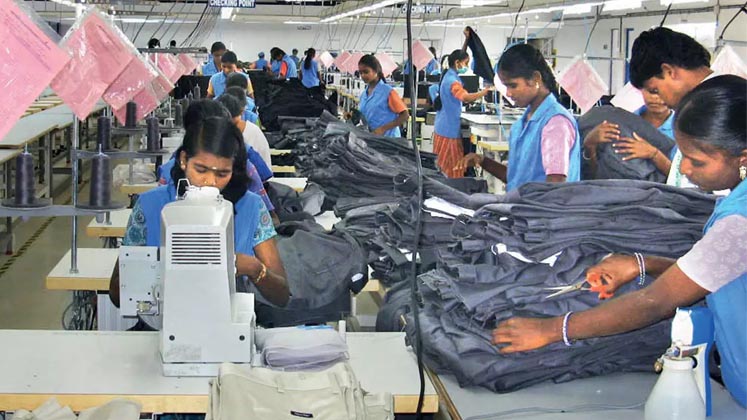
Apparel export is also a major segment for the state as overall textiles and textile articles (HS Code/Chapter 50 to 63) export contribution from Tamil Nadu is US $ 7.38 billion and out of this, Tirupur knitwear apparel export contribution is US $ 4 billion. There are around 6500 garment manufacturing units in the state. KPR Mills, Lakshmi Machine Works, Eastman Global Exports, Precot Limited are few of the leading giant textile/apparel companies of the state.
Long list of industry-friendly policies and focus on the entire supply chain
As far as the steps taken by Tamil Nadu is concerned, it will not be wrong to say that the State Government has long-term planning and is rigorously focusing on the root cause. The recent budget of the state is a perfect example of the same as it announced to create a separate department for textiles so that the textile industry can grow speedily and smoothly. To avail the benefit of Union Government’s scheme as well as to support itself, the State Government announced the establishment of textile parks and SIPCOT park with a budget of Rs. 1,500 crore with plug-and-play facility (a regular demand of Tirupur industry). Besides, new Common Effluent Treatment Plants (CETPs) will be set up for the benefit of the existing processing segments in Erode and Namakkal districts, construction of labour quarters in Chennai, Coimbatore and other places and much more.
Very recently the state unveiled the Tamil Nadu Export Promotion Policy and it will soon adopt a two-pronged approach–export promotion and export diversification, to achieve this objective. As per the policy, Tamil Nadu would develop two Economic Employment Enclaves in Manellore and Thoothukudi to ensure balanced growth of exports across the state. The state has identified 10 export hubs and shall strengthen export related common infrastructure projects in these hubs by reimbursing 25 per cent of the project cost, subject to a ceiling of Rs.10 crore per export hub. It would also be beneficial to textile and apparel clusters. The schemes formulated to provide special package incentives to encourage manufacturing of value added products would be increasingly beneficial for the Tirupur knitwear exporting units.
Accepting four-decade-old demand of the textile industry, the state also removed 1 per cent AMC cess on cotton and cotton waste. This step would attract several private cotton traders and Cotton Corporation of India (CCI) to open depots in Tamil Nadu and sell cotton on a daily basis to the SSI spinning mills.
As the majority of factories in Tamil Nadu are dependent on migratory labour and after Covid, thousands of workers from UP, Bihar, Jharkhand and Odisha have not come back to Tamil Nadu, labour quarters can play an important role in retaining these migratory workers with the Tamil Nadu’s state textile and apparel industry.
The decision to improve the necessary infrastructure for the promotion of technical textiles and also completion of Integrated Textile Park in Tirupur was highly required. Skill Department Centre at ITI and single window clearance have also been announced by the State Government. To give relief to the entrepreneurs, the Amnesty Scheme for settling the disputes of older cases of Value Added Tax (VAT) has been announced.
The state is also pushing for technical textile investments and it has signed up for Techtextil India 2021 – the leading international trade fair for technical textiles and nonwovens.
All this shows that the State Government has tried to touch nearly all the requirements for the textile and apparel industry. In February 2021 Tamil Nadu announced its Industrial Policy 2021 and MSME Policy 2021. In May 2021, the Government has also come up with concessions to MSMEs.
Along with the industry-centric support, the state is also improving its infrastructure which will help the industry at various levels. Coimbatore and Tirupur are the two biggest hubs of the state. Extending the Coimbatore metro rail project up to Tirupur city would help a large number of commuters.
Industry’s reaction
Some of the leading apparel exporters of the state are very much happy with the aforementioned initiatives and are expecting good growth in coming years. These exporters believe that the combination of favourable policies at both levels (Federal as well as State) will give a push to the industry in the state.
Some of the industry experts believe that they have not seen such positivity and vibrancy in the state’s textile and apparel industry in the last 8-10 years. “Things are moving on the ground level as with beneficial policies, multiple factors are also in the favour of Tamil Nadu’s industry. Export orders are increasing, the domestic market is also improving so the entire value chain of the state is getting the benefit of policies as well as the market conditions. This is creating confidence and trust among the companies and so they are planning for capex, modernisation,” says Prabhu Damodaran, Convenor, Indian Texpreneurs Federation (ITF). Coimbatore. ITF is a leading trade body with more than 500 members representing the entire textile supply chain.
Logu K, Chairman, AKR Industries, Tirupur says, “One of the best things is that our State Government understands the textile industry deeply and our CM is approachable. These policies should help us to achieve more growth as normally we grow between 5 per cent to 10 per cent but in the next few years, this growth can be double of the exiting growth level.” He further adds that State Government is working on some more plans and soon industry can get more support. Having state-of-the-art manufacturing units, AKR Industries is one of the well-known apparel exporters of the state.
At the same time, few of the apparel manufacturers believe that though steps taken by the Government at both levels are good and may work like boosters for the industry but it is too late. Especially looking at the skyrocketing yarn prices and issues with containers availability, high freight costing… it is difficult to bring back their business on track. “We welcome all these initiatives but it will take time for proper and smooth implementation of these policies and to create a positive impact on ground level. And I don’t see any immediate solution to major issues like raw material price and logistic problems,” says Zahir Sait, Director, International Trading Company, Tirupur. The company is known for sweater manufacturing.
A major concern for the apparel manufacturers is the upcoming hike in the state’s minimum wage which has not been increased by the State Government from last two years but is expected to increase by the end of this year. As of now, as per the State Government rules, the minimum wage in the state is Rs. 8,010 for semi-skilled operator and Rs. 5,610 for a helper which is quite less compared to other apparel producing hub. The apparel manufacturers claim that they are paying an average of Rs. 10,000 to Rs. 12,000 to skilled operator and any further hike in this will be a big pressure on the costing.
Ravi Singee, Director, Magnum Clothing, Chennai says, “Any decision in this regard will be crucial and business will depends on the minimum wage scenario.”
Industry stakeholders also highlight that the state’s textile industry has huge participation of small-scale players especially thousands of jobworkers who are an integral part of the entire supply chain. Hence, the benefit of the policies should reach these small-scale players/job workers.
No doubt, challenges are plenty for textile and apparel manufacturers but it is also rare to see the State and Union Governments take positive steps together. Tamil Nadu’s players have art to survive and there is definitely strong reason to believe that the state will have good growth in future.