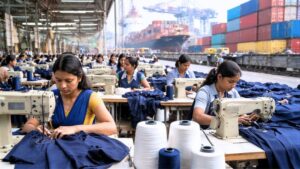
In a mega event that caught much attention of even the mainline media, Textiles India 2017 was prompted and developed on the vision of Prime Minister Narendra Modi. “From Farm to Fibre, Fibre to Factory, Factory to Fashion and Fashion to Foreign Exports”, saw a convergence of the who’s who of the textile value chain. Held in Gandhinagar, Gujarat, the event was a balance of many expressions – from round table conferences to workshop sessions to a grand fashion show – depicting the ‘Weaves of India’, and not to be overlooked by the 10 halls of exhibition space, housing players from all aspects of the chain, from cotton farmers to garment exporters.

There was a great expectation, as usual, from the PM’s inaugural address at Mahatma Mandir, about one-and-a-half kilometres away from the exhibition venue, but the industry did not receive any significant announcement. “We were expecting at least something significant at such an important event, but the PM stayed focused on the theme of Indian textiles without making any announcement that could have brought cheer to the VIP gathering,” said Sanjay Jain, MD, TT Industries. During his address, the PM urged the industry to invest more in innovation and research that could boost textile exports. Putting a thrust on organic products, Narendra Modi said, “We should catalogue and map our clothing diversity and clearly earmark strengths and specialties of each state or region. Each state should appoint nodal officers dedicated to a few well-known products, who would facilitate producers and traders across the value chain. Today, there is a demand for products with zero carbon footprints as holistic lifestyle has become a buzzword. The market for organic dyes, clothes and fabrics made from organic products is growing. Our effort should be to innovate in organic products. I call upon you to come, invest and ‘Make Textiles in India’.”
During the three-day event, the textile sector witnessed the signing of 65 MoUs in various segments. The ongoing conferences were a delight for those looking at much more than products. At a conference on ‘India as a Global Sourcing Hub & Investment Destination’, Gautam Nair, Managing Director, Matrix Clothing, brought up the concerns regarding GST. “The GST implementation has brought in serious uncertainty, particularly to exporters. Will we be refunded all the embedded taxes, what about those taxes not covered under GST?” he questioned. He added, “Whereas a bulk of the world market is into synthetics, India competes in cotton and related segments, while China straddles the whole market place. Labour laws are a huge constraint deterring large-scale corporate investment and the sector gets no duty advantage from EU and Canada, unlike our competitors like Sri Lanka, Pakistan, Vietnam and Bangladesh.”

As part of the event, two fashion shows were staged. The first one was on the ‘Evolution of Textiles of India’ to present a compelling story of the Textiles of India; and another was the ‘Indian Handloom Show’, which presented the story of the India Handloom brand initiative launched by Prime Minister Modi on National Handloom Day in 2015. Many well-known and young upcoming designers showcased their collections with pride.
“Just being short-listed to showcase my handloom collection, is an honour,” said designer Manish Tripathi, who heads the iconic menswear brand Antardesi.
Manish is National advisor to the Ministry of Textiles for India Handloom Brand and has set his eyes on developing modern interpretation of Maheshwari fabric to support the weavers for more commercial business. For the designs and colour palette of his collection, Manish took inspiration from the picturesque forts and palaces of Maratha queen Rajmata Ahilya of Maheshwar and the flora from tropical forests of Madhya Pradesh. To add to the details in the garments, mukaish, hand and machine embroidery, block prints, and few other intricate techniques were used.

The event saw great appreciation from all quarters for brand ‘Textile India’ with all major names in textiles represented at the event. “India is such a large textile and apparel manufacturing country, there is so much skill in this regard. I think this event is helping to see all the strength of textiles that exists in India. I think people will take some learning out of here and we will see more and more people look at other opportunities. One of my exporter-friend shared that he could not believe that India does so many things. I think MoT has looked out for the strength of Indian textile industry and has led from front in trying to bring everybody under one roof.
I hope that we will be able to build this event into something much larger in years to come,” said Rakesh Biyani, Joint MD, Future Group.
He was at the event with his sourcing and buying team. “Three days are too less to identify and hold partnership meetings but it’s a beginning. As we are growing our business substantially in the country, we are looking for new manufacturers, new partners. This is going to be a good event for us as we will be able to connect with many new suppliers,” he added.
Textiles India was good enough in terms of round table discussions as they covered numerous aspects of the entire supply chain and experts from across the globe participated in these discussions. Many top ministers and bureaucrats were also involved in various sessions and they discussed how their ministries can work together with MoT/textile industry.
Sadly, while textiles was a major thrust area, the garmenting segment was not brought into the limelight. This was clearly reflected in the satisfaction level of the participants of both segments.
“We are very happy to be here as it gives us an opportunity to network with the industry and also meet our ‘buyers’, the garmenting segment for fabric and textile mills for yarn under one roof,” said Yatish Pandey, Chairman and Managing Director, Texperts India.
The same sentiment was shared by most of the textile companies, who felt that their participation at the event was successful. On the other hand, garment exporters were very unhappy as foreign buyers were very few and not many of them were big buyers’ worth mentioning. However, everyone agreed that the concept was interesting and had potential if done properly.
Big domestic brands well represented… International buyers were mostly new buyers
The domestic buyers were from various departments of the same organization representing different brands and product categories. Ekta Jain, Head Garment Technology & Quality, Westside (Trent Limited), Mumbai visited the show along with Umesh Nataraj, Technical Manager – Menswear, Flora Services (Trent Limited). Similarly, from House of Anita Dongre Limited, Mumbai, Himadri Datta, VP – Head Sourcing and Navin Kumar, Lead Fabric Sourcing & Planning, were also seen discussing business with the exhibitors. Similarly, a strong team from Future Retail Limited, Mumbai and some more such companies too visited the show.
Ekta shared, “Our aim in visiting this fair is to understand the overall market; how retail market is moving towards new technology and what new is happening on the fabric and allied side. There were some valuable discussion forums in the event like ‘Size India’, so that we could have a better idea about the entire market situation and other retailers, and what new developments we could extract from here.” She further added that consistency of quality across all the vendors in the same buying frame is a major challenge in sourcing. “As concepts like artificial intelligence, industry 4.0, 3D printing is growing, we have to keep ourselves upgraded to that level and continue offering something new to our customers.” The company is running programmes for its vendors to educate them about quality.

The fair was dominated with small- and medium-level overseas buyers; and some of who are just going to start their sourcing from India. For these people, it was their first ever visit to India. Some of the buyers were really enthusiastic about sourcing and were looking for further growth prospects. With the purpose to support a charitable foundation Freedom on Ice, Nepal, Laura Levtov, Founder Director, Powerskating Academy, Toronto, Canada, is currently dealing with a Nepal-based factory and sourcing small orders. But she does have aggressive plans for India sourcing, “We want to sell across the world with focus on ice skating garments like hockey jacket, performance dresses and some value-added garments too. For this we are meeting some Delhi-based companies, where we will see their infrastructure and process. I am looking for exclusive products and am excited to start sourcing from India.” She also stated that the fair shows the efforts that the Indian Government has put in, not just for the booths but even for education and awareness of the textile community.
Buyers, especially those who visited India for the first time and are not well aware about the overall textile strength of India, were quite happy with the show. Some of the products as well as the rich textile heritage of India really impressed them.
Running one store, Nancy Gichane Machira, MD, Magnificent Interiors, Nairobi, Kenya is focusing mainly, on interior design and has clients into hospitality and medical sector dealing mainly into home furnishing items. Currently sourcing from China, Nancy, who will start sourcing from India soon said, “I want to enhance my reach into global markets rather than just focusing on Kenya. I am accessing similar platforms across the world where I can find suppliers as well as customers. I am increasing my communication with all perspective clients. This is my first visit to India and I found that India has good strength of fabrics.”
Earlier sourcing from US, Victoria Holmberg, Owner, Victoria Holmberg Vestidos, Buenos Aires, Argentina, is now going to start sourcing from India and will focus on products like eveningwear and resort collection. She claims herself as a growing wholesaler buyer and it was her first experience to visit any fair in India. Zaid Hashim, Director, WCH International, Colombo, Sri Lanka, approaching new markets like New Zealand, Australia and England, is also in the process to start sourcing womenswear and accessories from India. Currently he is selling online, mainly in Sri Lanka.
Some buyers who are already sourcing from India are fighting on the price front and it is a big concern for them. Sourcing womenswear and home furnishing products only from India, Oliver Sarl, Villaret, Toulouse, France, is a wholesaler and retailer as well. With 3 stores, he also caters to Japan, Russia, Scotland, Italy and England through his wholesale division. “Currently, we are sourcing very small quantity from India (30,000) pieces per year as price is a big challenge, but as I sell expensive pieces (starting Euro 12 to Euro 250), my overall sourcing from India is reasonable.” He further added that business is going to be very difficult, since one of the biggest problems is the large number of suppliers as well as retailers; so competition is growing at every level.