India’s premium talent discovery program – GenNext – has announced the winners for its 32nd edition who got the opportunity of a lifetime, of showcasing their talent in front of the entire world at the recently concluded FDCI X Lakmé Fashion Week.
In its course of being, GenNext has established more than 200 designers, and has been recognised for identifying and providing young and talented designers an opportunity to enhance their skills and take centre stage in the fashion industry.
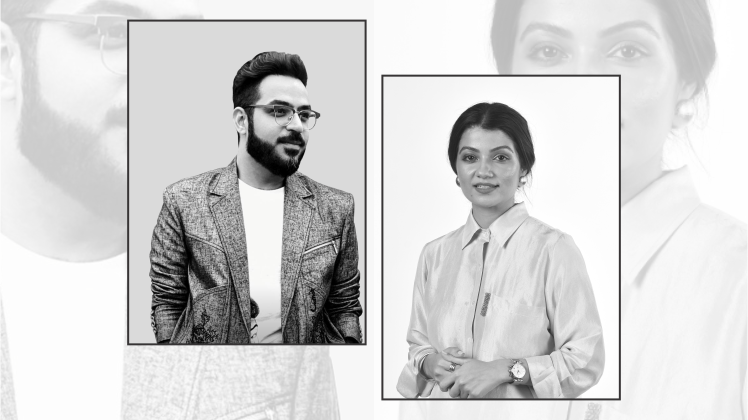
October 2021 saw 32-year-old Deepit Chugh from Mumbai, and 28-year-old Twinkle Hanspal from New Delhi, bag the prestigious title of INIFD presents GenNext designers, who were selected via a virtual jury selection process.
Applicants were required to submit a video montage of their ensembles to complement their presentation, and the ones who were shortlisted, presented their collections digitally to an expert jury comprising Tarun Tahiliani, Priya Tanna, Aashti Bhartia – Director of Ogaan; Sumati Mattu – Head of Innovations at Lakmé; GenNext Mentor Sabina Chopra and Jaspreet Chandok – Head of RISE Fashion & Lifestyle.
‘INIFD presents GenNext’, the most coveted talent discovery programme, has so far spotted over 275 designers and is providing talented designers to the ever-growing fashion industry just like the IPL and Under 19 World Cup cricket tournaments spot for the Indian cricket team,” Anil Khosla, Global CEO of INIFD said adding, “We are the only design institute to present 2 shows at Lakme Fashion Week and also the first to provide a platform to its students to showcase at London Fashion Week for 7 seasons and New York Fashion Week for 4 seasons.”
Let’s get to know this year’s winners better and what exactly made them stand out from amongst a pool of abled contestants.
DEEPIT CHUGH
Age: 32
City: Mumbai
Deepit graduated in design from NIFT, New Delhi, and had the opportunity to work with Pantaloons, PARX at Raymonds prior to starting his own menswear label amidst the pandemic, last year.
His label Line Outline creates wardrobe solutions for the modern man.
The products on offer include shirts, tees, casual jackets, formalwear and trousers under the categories of casualwear, smart clothing and occasionwear.
Priced at Rs. 5,000 onwards for shirts, Rs. 9000 for kurtas, Rs. 16,000 for jackets and blazers, the label aims to provide easy separates for a versatile wardrobe.
The brand’s USP revolves around providing ready-to-wear clothing with a fluid narrative, all the while blending in clean tailored looks with sporty minimalism.
“While maintaining the aesthetics of the brand, we hope the customer sees us as a one- stop shop for his wardrobe needs. From casual dressing, to getting custom designs and contemporary Indian looks, the designs reflect a smart and modern vibe,” Deepit Chugh told Apparel Resources (AR) in an exclusive interview.
The brand Line Outline is a COVID-19 baby which was launched in October 2020.
During the first lockdown, Deepit realised that the number of local tailors and craftsmen who were running their own small businesses, either from their own homes, or out of small units in and around their homes, were completely out of work and had to shut down their businesses. This gave his concept a push, and encouraged him to work with these local tailors in order to maintain a healthy number of orders, along with teaching them better finishing.
“Our collections are seasonless and are called chapters. The range we offer is large which caters as a wardrobe solution rather than a one occasion/type of clothing. We manufacture based on orders only and provide standard sizes from S to XXL, along with an option of customisation for all our products,” Deepit highlighted.
| AR: What, according to you, is driving consumption in fashion and apparel categories in the Indian market?
DC: I think ease of wear and multi-wear fashion garments are driving consumption in today’s apparel categories. From elevated basics to clothes that are unisex are the way forward. |
THE WINNING COLLECTION
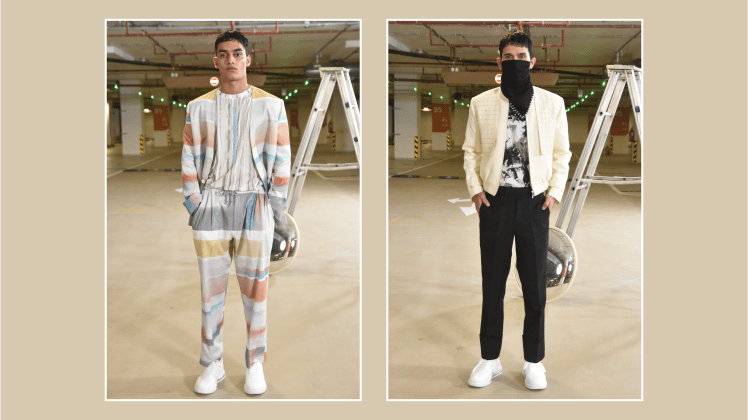
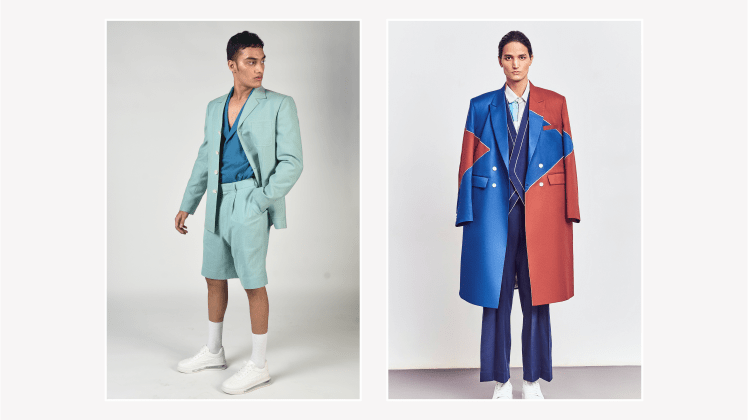 Deepit presented his winning collection, ‘IDYLL’ at the FDCI x Lakmé Fashion Week joint phygital showcase, as a virtual film. The collection paints a story of a utopian life, one that is hopeful and energetic.
For his debut collection at the fashion week, Deepit has tried to bring forth a break from the crisis we are facing, in a world with freedom and expression – an escape into what we could be.
The brand takes its visual inspiration from coloured brutalist architecture for this collection which is created using soft cottons, cotton blends, bemberg silks and twill fabrics, featuring prints that are made entirely in house and with hand done embroideries. Minimalistic hand embroidery techniques such as cording, pitta work and zardosi elevate the garments.
The ready-to-wear collection comes in easy silhouettes with a focus on colour blocking and pattern play, with an aim to accentuate the wearer.
Stand-out pieces and details include navy trousers and an asymmetrical waistcoat – both in poly blend, a crosshatch weave, worn with a white digitally printed shirt in cotton satin, topped with a red-blue colour blocked twill trench coat featuring wide lapels with contrast piping.
Commenting on the same, Deepit said, “The brand focuses on minimalistic embroideries that accentuate the product rather than making it about the technique. We play with patterns and the cut n sew technique while elevating classic silhouettes.”
The collection highlights baggy silhouettes with a marked emphasis on seaming and piping, as well as wide lapels, off-centre closures and contrast insets for jackets. Prominent buttons lend a masculine touch to the men’s jackets.
Currently comprising a small team, the brand outsources most of its work from local community tailors and embroiderers.
“From our jackets getting made in Nalasopara, to embroideries being done in Juhu, to our shirts and trousers being made in Mulund and some of the elaborate pieces being done in Bandra, to our fabrics getting printed in Surat and New Bombay – we work with really tiny teams running super small local businesses, each a master of their own craft,” Deepit highlighted.
TWINKLE HANSPAL
Age: 28
City: New Delhi
After graduating from NIFT, New Delhi, Twinkle had successful stints with many designers including Ritu Kumar, Anamika Khanna and Ridhi Mehra, prior to venturing into the industry herself with her own eponymous label.
Embodying a minimal, yet statement aesthetic tied together with elevated essentials derived from Indian classics, the label offers semi-formal fashion that underlines comfort and a relaxed appeal as its main forte.
“Wearability and versatility are the main USP of our brand. Anyone with a strong sense of style and the urge to experiment with their look is a perfect fit for our label. Our inclusive design language welcomes all, irrespective of age, gender, shape or size.” Twinkle Hanspal told Apparel REsources in an exclusive interview.
Launched in September 2017, the label initially started off with westernwear and later forayed into contemporary indo-western styles.
Priced between Rs. 8,500 and Rs. 45,000, Twinkle Hanspal – the label, currently offers a wide range of separates, dresses and co-ord sets under the westernwear category, whilst the indo-western line extends to include pre-stitched sarees, draped skirts, dresses, jumpsuits and co-ords.
Over the years, the label has managed to create a signature style of its own, which includes lots of cording, belts and wrap-drapes that bind its aesthetics together.
The label manufactures all its products in-house that are carefully handcrafted under one roof.
“We are a small but strong team of 10 people, nestled in the heart of Shahpurjat in New Delhi. Our fabrics are both outsourced and developed by us in certain cases,” Twinkle said, adding, “We have fabric clusters working for us in Benaras and Surat, where we get our handloom chanderi, silk dupion and mashru developed from. We mainly work with fabrics such as cotton poplin, silk slub and mashru silk.”
India is famous globally, for its local markets and raw material sourcing hubs. Tapping on the richness of the region, Twinkle is locally drawn to Chandni Chowk and Govindpuri markets when it comes to sourcing raw materials for her label, that range from embroidery supplies to fabrics to yarns.
| AR: What, according to you, is driving consumption in fashion and apparel categories in the Indian market?
TH: Fast fashion has made consumers hungry for more in a very economical price bracket, and this has led to a recurring shopping pattern. Slow fashion on the other hand, is trying to make people rethink their fashion choices and invest wisely. |
THE WINNING COLLECTION
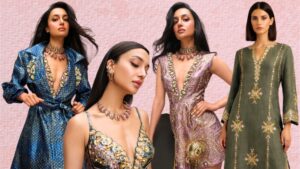
For her winning collection as the GenNext designer, Twinkle aimed to celebrate classic Indian silhouettes with a contemporary twist. Luxurious silks and breathable cottons are used together in order to weave a timeless story.
The collection features statement inserts with dabka, fabric-cording and line stitch forming a beautiful amalgamation of precision and craftsmanship.
The garments came in happy hues intertwined with a subtle palette that seamlessly translated into an array of colour blocked classics.
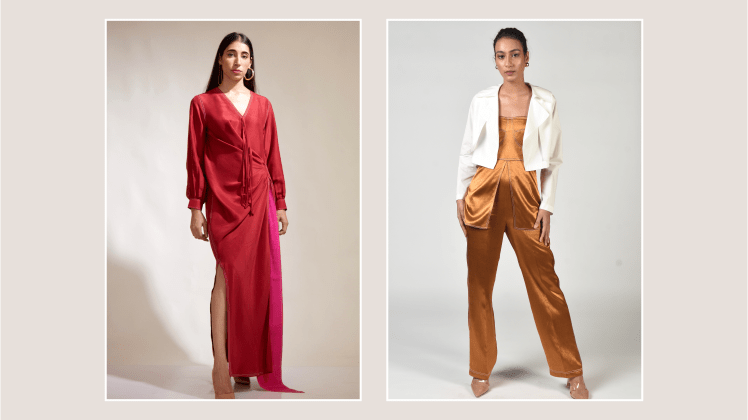
The collection is built on a modern union of the ‘East meets West’, wherein classic sari drapes appear to be a constant inspiration along with the dhoti, which came forth in a long-sleeved, red, maxi dress that featured a shocking pink inset and long fabric streamers gracing the garment’s ‘V’ neckline.
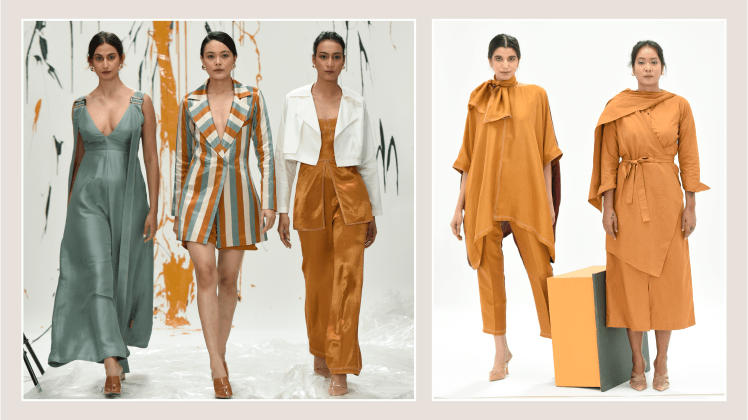
Stand-out looks include a white draped calf-length kurta with a front cascade and long-sleeves, which are paired with narrow pants, gave a new fashion direction to the traditional garment.
An interesting eveningwear option came in the form of a striking white sleeveless midi, that features a thigh high slit and a one-shoulder, draped, cascade.
“My journey with FDCI x LFW has been very fulfilling. The whole process helped me catalyse and break barriers around inclusivity in fashion. The label is not trend-driven; hence the design language is timeless. The future of fashion is inclusive, wearable and conscious which strongly influences our sustainable approach. A minimal yet statement aesthetic ties the brand together with a wide range of elevated essentials,” Twinkle Hanspal said of her collection.
At the onset, Twinkle Hanspal, the label, used to manufacture three collections per year but after the pandemic hit, the label is only concentrating on drop-based collections – one being an extension of the other.
Twinkle Hanspal currently manufactures sizes from XS to 5XL, and also takes orders in various cases.


 Bharat Tex Special Report 2026