Lakmé Fashion Week has long been regarded as India’s most prestigious fashion and design platform with a knack for not only delivering standout collections by established designers, but also identifying and nurturing a curated pool of unbridled, homegrown talent that proves to be a gem to the industry.
With such a vast lineup and creative talent that emulates the essence of Indian design and craftsmanship, it is no wonder that the biannual event attracts fashion buyers from all over the world.
Indian hand embroidery and textiles had put the country on the world map decades ago, but the disruption that is being created by the newer pool of designers on a global level is unprecedented. More and more people worldwide are waking up to and acknowledging the creativity served by Indian labels. Furthermore, the blurring of barriers, both geographical and cultural, have made design coexist among different castes and creeds. With all this at the forefront of the global dialogue, it is no surprise that many a hawk’s eyes are fixed on the subcontinent.
Due to the similarity in cultures and cross pollination of tradition, India poses as a rich hub for buyers from the UAE, the Gulf countries, Japan, US and Europe. It is also no secret that London features amongst one of the top markets for Indian wear alongside the US and Middle East which has seen a spike in the number of multi-designer stores catering to this well-pocketed consumer base. Lakmé Fashion Week occurs at the ripe moment wherein these countries prep up for their upcoming seasons; many international buyers find the Mumbai (Lakme Fashion Week’s) timeline to be much better as compared to Delhi’s FDCI LMIFW, since it happens in February, and March becomes too tight owing to the onset of international coverages in London, Milan, Paris, and Italy.
A major point of concern for buyers, over the last few seasons, has been the purchasing power of consumers. As discussed in our last season’s buyer report, consumer spending has been a major pain point among not only buyers, but designers as well. Given the grim situation caused by the ongoing trade wars between nations, the Trump effect and Brexit, an obvious downward spike has affected businesses all over the globe – something that has seen a huge uptick this season! Designers have identified the gap in the market and have corrected their pricing to suit the millennial consumers more. We have also noticed a trend in the market, especially over the past few months wherein an umpteen number of designers have been seen coming up with pret and diffusion lines which are more affordable.
Another long-set solution has been customisation, which meets not only the concerns of pricing, but also of viability across demographics. Majority of fashion buyers across the world regularly work on a customisation model with designers to create exclusive one-of-a-kind pieces for their clients, all at the same time, keeping the brand language of the designer alive. This, in turn, allows designers to reach wider pockets and an international audience. Overseas business forms a big chunk of revenue for Indian designers; if pricing is met with qualitative demand, India has a profitable opportunity to claim its position as one of the top luxury retail destinations worldwide.
Team Apparel Resources had the chance to meet well-informed fashion buyers from some of the top fashion retail businesses worldwide including the UK, the Middle East, and Russia to bring to you the insider report on what the current market pulse is all about, the standout Indian designers this season, and the top fashion trends for 2020.

Svetlana Kuzovova, Founder & Creative Director, Asian Spirit, Moscow, Russia
Svetlana Kuzovova, Founder of multi-brand designer store Asian Spirit based in Moscow, Russia, collaborates with Asian designers from India, Emirates, Mauritius, Lebanon, Uzbekistan, etc. on limited edition exclusive pieces. With a client base covering the entire world, Asian Spirit operates on both brick-and-mortar and e-commerce business retail models including social media platforms such as Instagram as well as some online shops that cater to specific demographics.
“India is our biggest market for sourcing fashion garments, and we have been coming here for more than 10 years now. We work with all the key couture designers and pick collections that we find are interesting and then we work with the designers to westernise the designs by changing some silhouettes, or reducing some embroidery, or changing a few colours, fabrics, and patterns to appeal to our market,” said Svetlana.
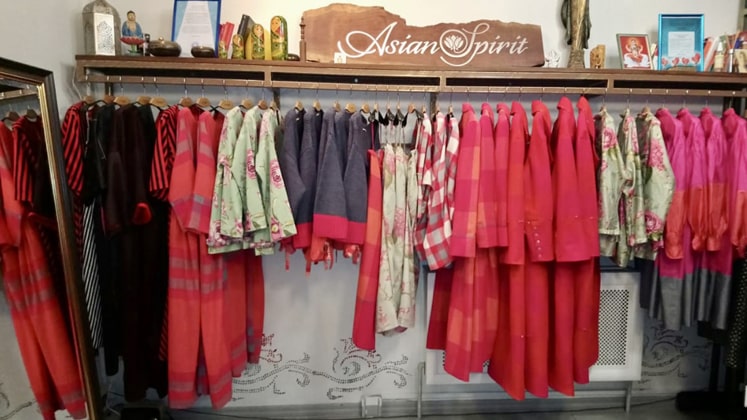
Some key points that this Moscow-based fashion buyer considers while shortlisting key pieces for a season include the finishing of the garment and quality of fabric. The colour should not run and the embroidery should be very precise so as to ensure that the garments are comfortable to wear and easy to take care of.
“What India as a country has to offer in terms of designs is not available anywhere else. We value that, and that is what our clients like.”
“This year, we came to specifically look for new, fresh talent because we aspire to present something new to our clients each season. We really liked the denim line presented by Abhishek because denim, as a fabric, is in fashion now, and especially in our country, we are working on curating a denim-based line. We also really liked the work of Delhi Vintage Co.,” Svetlana highlighted.
Standout Designers –
Tarun Tahiliani, Malini Ramani, Pankaj and Nidhi, Wendell Rodricks, Pero
The store usually picks around 2-3 brands because their business model requires them to work one-on-one with the designers a lot on creating a collection that meets their demographics and consumer preferences – a task that can emerge to be very time-consuming. “Our MOQs vary from 30-100 pieces per designer, depending on how much we like a particular collection,” Svetlana explained, adding, “Sometimes we focus on specific pieces, but we try and keep ourselves inclusive so we don’t do too many pieces per style. We do one style in 2-3 pieces in different sizes and different colours.”
The Moscow Market
Aflood with designers from all over the world, the Moscow market is a very competitive space today, thus matching quantity with quality and ensuring a very strong DNA are vital for brands and labels looking to succeed in this market – something that Asian Spirit exceeds at doing. “Good quality and reasonable pricing strategies are key. People these days prefer to invest more in accessories. They don’t mind buying expensive bags and shoes, but they are happy with wearing Zara clothes along with them.” Svetlana elucidated, adding, “I would like Indian designers to also keep up with this trend and use their amazing fabrics in a way that is easy to wear and take care of. The consumer mindset has also shifted toward renting instead of hoarding – they don’t buy anymore.”
A market that is still price sensitive, brands that are well-priced thrive in Moscow. Pricing was, thus, an aspect of concern for Svetlana. “I understand that handwork and embroidery are tedious design processes and have a cost attached to them. We always try to negotiate since we also have very expensive custom duties in our country and since we levy this cost, it already hikes up the price to almost double.” Svetlana corroborated, “I try to reduce the price by reducing the embroidery, etc., but it would be nice if Indian designers price their products lesser. Having high prices means that we enter the luxury market segment which, in itself, means being in the league of and competing with the likes of Gucci, Prada, etc. In such a scenario, we have to be better than them to convince the consumers to buy certain brands that may not enjoy global popularity as these brands do.
In the digital age, it is of utmost importance to keep your clients engaged and updated with the latest trends and labels in the market. Asian Spirits is constantly educating its clients by doing their own fashion shows for them, offering loyalty programmes, holding lectures, etc. “We take immense measures to make our clients choose any brands we carry in our store. Our clientele is able to afford luxury, but at the same time, they are always looking for something different and unique – some design or brand that nobody else has, and that’s how we appeal to them via our channels,” Svetlana concluded.
Ashvinder Virdi (Ash), Founder, Estee Couture, London
It is no secret that London features amongst one of the top markets for Indian wear alongside the US and Middle East, and we have seen a significant number of multi-designer stores catering to this well-pocketed consumer base. Amongst so many choices, it is imperative to maintain a USP to understand clients and simplify their experience in order to stand out.
London-based Estee Couture has been stocking designers and labels for over 5 years. Currently carrying 25 designers, the multi-designer store is always on the lookout for new prospects to add to their offering. Estee aims to provide a one-stop solution for consumer needs when it comes to occasionwear. “We try to ensure that when a family comes to us, they can pick up outfits for multiple occasions – be it a mehndi, a welcome day party, a sangeet, a wedding day or a reception. We try to stock a range of designers who can cater to a bride and her family, her trousseau, bridesmaids – everyone,” said Ash.
Standout Designers –
Payal Singhal, Masaba, Ridhi Mehra, Amit Aggarwal, 29, Amaare
“Lakmé Fashion Week never disappoints! It’s been a very lucrative and exciting trip this season. There have been some great new designers who we have come across and some existing ones that we have been stocking. The likes of Payal Singhal, Ridhi Mehra, and Masaba have great collections for the season. Masaba has got a gorgeous collection for Spring/Summer – a lot of our clients in London prefer her garments which embody western cuts – especially for fun events like welcome parties, brunches, etc. Amit Aggarwal is also amongst my favorite Indian designers, so I am looking forward to his collection,” Ash highlighted, adding, “Amongst the newer crop, 29 was a favorite of mine – the work that they have done with mirrors is something I found very authentic and something you can wear, be it East or West. I am also a big fan of Amaare – we are just about to launch our menswear line at Estee, and we will be introducing Amaare there. Sahib Bhatia’s collection was amazing for the men of today who prefer understated aesthetics, “ Ash concluded.
Shaima Alfadhel, S Style Group, Kuwait
Frequent visitors at global fashion weeks and exhibitions, S Style Group has seven multi-brand designer stores in Kuwait. From India to Mexico to Australia to London, Paris, Korea and New York, S Style Group travels around the world to identify and partner with different brands to stock them in their stores.
“We think this edition of Lakmé Fashion Week is by far the best fashion week/exhibition attended by us in India.” said Shaima, adding, “This time, there is a lot of choice available, and many designers are presenting different styles. The cherry on the cake is that the designers present here have now become so well aware of the Middle-Eastern tastes that this time they introduced some fabrics that are more suitable to our clientele. They have varied silhouettes that feature plenty of options in full length styles, full sleeves, etc. Generally, we have to work with designers to create some changes to suit our market, but this season, we didn’t feel the need to alter designs too much.”
Since they have seven stores, there is no minimum or maximum number of pieces per style that they pick up from a designer collection. If they see a collection they like, they go and make a selection. Because of the climatic conditions in Kuwait, the consumers prefer very lightweight fabrics along with longer cuts.
“We are a regular at Indian Fashion Weeks. We have also been attending FDCI LMIFW since 12 years, but this season, I will not be going there because I have got a good collection from Lakmé. I don’t want to put only Indian designers in my store so I make a selection and visit different countries.” Shaima said.
Standout Designers –
Ikai, Gauri and Nainika, Mohammad Mazhar, Pankaj and Nidhi, Samant Chauhan, etc.
Since Lakmé Fashion Week happens in February, the timeline is preferred by S Style Group because March brings the onset of international coverages in London, Milan, Paris, and Italy.
“Even the atmosphere here is much nicer since they take exceptional care of each and every detail and we don’t feel uncomfortable for anything. All our needs are met, but the same case is not applicable in Delhi,” Shaima concluded.
“Pricing is a concern. We try to mention that this is not retail; this is wholesale and if we take garments at that price, then it won’t sell that well. There are some designers who can and some who can’t meet that in cases of which we work on alternating the designs.”

Atinirmal Pagarani, Vesimi, Dubai
Following the policy of having one and killing it rather than having more and thinning it, Atinirmal Pagarani of Vesimi recently moved his popular Dubai-based multi-designer store from Jumeirah to Business Bay.
Constantly growing their base of existing designers by adding new and emerging talent for consumers to experience something new at all times, Vesimi also houses a few Dubai-based and Pakistani designers apart from their majority share of Indian designers.
“I have a lot of non-Indians coming to me now as well as a lot of Pakistanis who love Indian garments – and since they can’t directly shop from India, Dubai serves as the perfect transit city for such purchases, and we at Vesimi, are happy to fill that gap,” Atinirmal said.
Since Vesimi attracts a huge number of Muslim clients, over 65 per cent of their orders are customised to suit their market. There has been an increased demand for hijabs as well – so all kinds of customisations right from colours, to adding scarves, to adding shehlas, to somebody wanting no sleeves, to somebody wanting full sleeves are done on a regular basis.
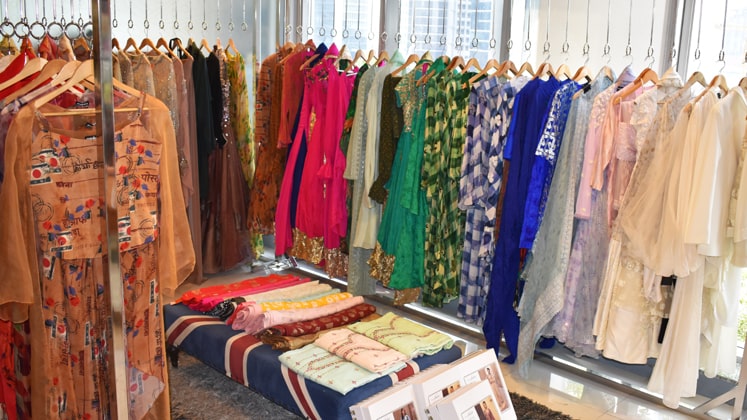
“29 is a label I really, really like; their concept is really intriguing wherein they plan to pick up one state at a time from among 29 states in India and recreate a technique popular there. They have started with Gujarat, and made the bandhani and mirror work popular there. I don’t think that the designs they have created using these techniques have been treated that well by anyone else, commercially. They have kept the price points really simple and their designs are very tasteful,” Atinirmal said.
“Pooja Shroff has also come out with a very stunning collection with colours that are extremely wearable. Masaba is an all-time favourite with her quirky prints and her price points are very commercially viable ensuring that her designs are always a fast seller. Kunal Anil Tanna has been really creative with his menswear designs, Sahib Bhatia’s Amaare for menswear, again, is also very interesting.”
Standout Designers –
29, Pooja Shroff, Masaba Gupta, Kunal Anil Tanna, Sahib Bhatia
For Atirnirmal, the price points of Indian designers have been a breeze this season. Keeping the liquidity crisis in mind, corrective pricing is key to retail success. Commenting on the same, Atinirmal said, “Designers have realised how pricing plays a key role in making a collection a success. A lot of designers today are trying to be sustainable – not only by using certain fabrics, but also by considering that people are upcycling, downcycling, recycling everything. Ladies are coming with their old blouses wanting to do something new with them – so the intention for someone buying something new is a little lesser now – and designers are realising that.”
Some of the best-selling designers at Vesimi include Ridhi Mehra, Arpita Mehta, Anushree Reddy, Masaba, Anish Aggarwal, Kunal Anil Tanna, and Elan. Even though that’s not an Indian label, but it’s worth mentioning here.
Devangi Nishar Parekh, AZA, India
“What I really liked this season was this shift to having real women on the runway rather than just models all the way. In this regard, Shades of India was one of my favourite shows, where as real women walked the runway, a screen at the back flashed their names, their professions, etc.,” Devangi stated. Women from various backgrounds and professions – be it a lawyer or an interior designer or an architect – made a very powerful statement. Even Pooja Shroff followed the theme with her mother opening her show in a white, pristine sari – which was super relatable. “You understand a garment a lot better when a model wears it,” she said.
In terms of the collections, the Gen Next clan proved to be a surprise package for Aza – all five of them. The dynamic entrepreneur praised Graine for their immaculate finishing and mentioned that even though they were very simple in terms of the aesthetic, they were actually very strong in terms of their overall collection – very wearable.
“I also really liked this new designer OUSHK and Delhi Vintage Co., both of which have great potential. Among the existing ones, I loved Kannelle; they were very fresh and I loved the pretty ruffle sleeves and statement sleeve detailing that they’re doing this season. Taneiya Khanuja’s statement dresses and westernwear were very interesting and I loved SVA’s prints. Also, Abhishek Sharma is my current favourite,” Devangi said.
Aza is known for its straight off-the-runway collection with all their designers – as we spoke, they had already gone live online with more than 15 designers, enabling clients to place an order right away. Similarly, at the store, they do in-store promotions – their latest one is being with Kotwara.
Apart from straight off-the-runway looks, Aza also does a more commercial version of those garments for their clients. This involves working closely with the designer in terms of an aesthetic that typically sits with their clients. “For example, if our clients prefer full length pants over cropped lengths or if they prefer longer sleeves versus shorter ones or different colours in some cases, we undertake those changes, while maintaining the designer’s sensibilities at the same time,” Devangi explained.
These drops keep happening through the season and they vary from city to city. Take Delhi and Mumbai, for instance. They are very different in the way they buy, and even within these cities, store to store variation is observed; the collection would be different in Juhu, Altamont Road, Delhi, etc.
Commenting on the same, Devangi said, “Delhi is open to wearing heavier and more experimental sort of garments, whilst Mumbai is a lot more subtle. Bandra is more experimental, Altamont is more classic and bridal, whilst Juhu has more of an NRI clientele coming in, so we typically tailor our merchandise based on a particular store.”
“The brand nowadays is like a person; they want to speak to the brand, they want to relate to the brand, they want to identify with a brand, so in the future, it will become very important for brands to have their language really clear and to be able to continue that sort of communication with the client cross all their different platforms – be it on Instagram, or in-store or online,” Devangi concluded.
Also Read: Fashion industry’s reset plan to cater to changing consumer demands during COVID-19




 Bharat Tex Special Report 2026