Held at a crucial juncture when the industry is in most need of work, the 43rd IIGF received mixed responses from the participants and buyers alike. While the buyer turnout was impressive with 556 buyers and 347 buying agents registering over the three-day event, according to the organizers, the fair also saw delegations from Japan, France, Kazakhstan, Uruguay and Belarus, besides some from Mexico, Brazil, Colombia, Spain, Uzbekistan, China and Thailand.
Fashion accessories, dresses and tunics were among the products that drew much attention. While some buyers felt that there was not much different on offer at the fair, many others came forward to say that IIGF was about a wider collection of the ‘same’ products and that is where the strength rested. “India’s strength – ladies fashion – is on show and buyers are by and large coming in, expecting to see this category,” said Fiona Jenvey, CEO, Mudpie, UK.
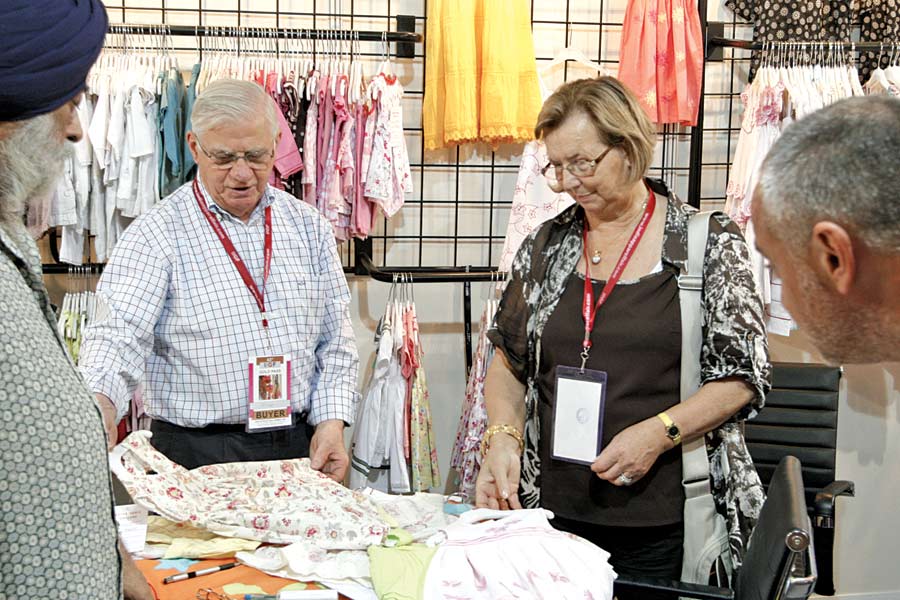
No doubt, women’s wear dominated the fair. Dresses were everywhere. “Buyers were asking for dresses in almost every style with floral prints the most in demand,” said Sreeram Sopra of Sopra Overseas, Jaipur. Karen Hutchings, Director Goose Island, a UK-based wholesaler supplying women’s wear and fashion accessories to more than a thousand stores, was happy with the array of products in women’s wear. “I found many interesting pieces and prints are very unique in India,” she said.
While tie&dye, aari work, sequin work, waist emphasis and pleats besides prints made dresses and tunics interesting, the range in accessories was wide from bags, scarves, footwear and belts to jewellery. Orom Ezra from Israel who sources the complete range of fashion accessories from India was looking to open an office in the country. “There is great variety in the country and the balance of modern and traditional applications make this category interesting for the international audience,” he said. Material like brass, bones, wood and metal were most used in jewellery. Neckpieces were shorter in length and scarves were a major crowd puller.

“In accessories, bangles were in great demand by the buyers. Bangles in wood and resin were the most popular. In necklaces, mixed material is in fashion, a lot of natural material is also in demand in line with the trend to be eco-friendly,” said Gagandeep Singh Sarna of Sarna Bags and Accessories, New Delhi.
Hand and shoulder bags in canvas, printed cotton, and chiffon were hot items. Adorned with wooden beads, sequins and embroidery the bags attracted many buyers. “Cotton hand bags were the most hot selling product at our stall, followed by 100% cotton kaftans in bright colours and bold prints, which are really selling well this season,” informed Onil Sadh of Vani Ethnics, Noida.
Women’s wear dominated the fair as they attracted huge buyers. Aari work, sequin work and prints made dresses and tunics found lot of interest. The buyers looking for men’s wear were very disappointed. The range in accessories was wide from bags, scarves, footwear and belts to jewellery
Though the number of buyers was large, many of the buyers were very small boutique owners for whom minimum quantities of 500 pieces are also large quantities as they came looking for 50-100 pieces, which did not satisfy the exporters. “Many of the buyers who came were looking for very small quantities, which does not justify our infrastructure and the turnaround was also very less,” said Bobby Gill of Solace Exports, Delhi. Added another exporter, “Personally we do not have a problem accepting low orders but technically it is not feasible for the mills to supply fabric for such small quantities.” Sonjoy Sukheeja, Daksh International, Jaipur, further regretted, “There were not many new buyers at the show this year and we met mostly our regular buyers only.”

Though very few exporters admitted to having actually received orders, some were very happy to have made new contacts. “We received 12 serious enquiries from the buyers of various countries and each had a different need, there was no common design demand,” said Achal Jain, Owner, Delhi Stocklot, Delhi. Another exporter who expressed satisfaction at the response was Nitin Sharma, CEO, IIFA India, Jaipur. “Fifteen new buyers, mostly from Europe, took serious interest in our products.
Though there was no order booking on the spot but we are very hopeful as they were serious inquiries. The buyers’ insisted on cotton dresses in white with prints. Jodhpur prints also attracted them,” he said.
While buyers for women’s wear were generally happy with the collections, buyers looking for men’s wear were very disappointed at the small number of stalls that had men’s wear on display, only 11 dedicated stalls. “We came with much expectation but there is so little to pick from,” said Timothy Perchey of Phelak. Another wholesale buyer from Australia who preferred to remain anonymous said, “India is far behind Bangladesh in men’s wear and it is time that they move beyond women’s wear and offer more in men’s which is an expanding category.”

Some of the interesting products on display in the men’s wear section include T-shirts with rotary prints, yarn dyed check shirts, over-dyed techniques, poly-wool linen trousers, rexin patchwork on 100% cotton sweat-shirt, pigment prints, and patchwork embroidery on cotton woven shirts. Said Kamal Setiya of CE Fashions, a liaison office of a Poland-based buyer, “We are searching for products in polyester mainly for sports wear but there is little to see as almost everyone is showing only cotton.” While admitting that cotton is India’s strength, she felt that exporters are not expanding their product basket and that is one of the major reasons that Indian exports has suffered in the last few years.
Representatives from the Indian operations of M&S, Cold Water Creek, CE Fashions, Castro, William E Connor, Lofff, Continuum Buying Agency, Huma Moda Merchandising, Mondial Orient Limited, Resemblence to name a few also visited the fair. Most of them were critical of the collections at the fair. One of them again who preferred not to be quoted said that many of the collections looked similar and that there were very few stalls that had anything really different to showcase. Perhaps this is one of the main reasons that price can be negotiated so hard in India, as many exporters can offer the same product and if anyone offered a bulk quantity then the prices really dipped drastically in an effort to grab business.
The mix ’n match of buyer to exporter was befitting in most cases, as the smaller exporters are happier working with small quantity buyers and for years that is what IIGF has represented. In fact, over the years IIGF has become a platform for small and medium level players to interact with boutique and small chain stores from around the world, most of whom prefer to buy directly from the source. That is also one of the major reasons that big buyers despite efforts from the organizers do not take too much interest in the fair because neither do they find the quantities they are looking for nor the product profile that they require.
ITPO Fails To Deliver International Infrastructure…
Despite the best of preparations by the organizers with signage at regular intervals, buyer lounge, media centre, food courts, well laid out stalls, helpful staff and colourful stalls all presenting a pleasant arena inviting ‘business’ some participants were not fully satisfied and hall numbers 10 and 9 in particular saw some unhappy exhibitors on day one complaining about the air conditioning and general lack of arrangements for these two halls in comparison to hall numbers 11 and 12. The AEPC moved in quickly and 600 tonnes capacity of air conditioning was provided from day two onwards on a temporary basis as the ITPO infrastructure failed to deliver. “At Apparel House we had the advantage of in-house infrastructure, but here we are dependent on ITPO. We never shrink from our responsibility, and providing international ambience for both the exporters and the buyers is our commitment,” said Rakesh Vaid, Chairman, AEPC.
AO Team was disappointed to see the cleaning staff loitering around the corridors and sitting in the washrooms chatting… certainly not becoming of an international level fair. Dustbins were not emptied regularly and because the air conditioners were not working, the atmosphere was suffocating with no respite and no trained staff to handle the emergency. For an infrastructure like the Pragati Maidan and a fair of the magnitude of IIGF, ITPO should be more upfront and present a much better face of Indian hospitality to international visitors.