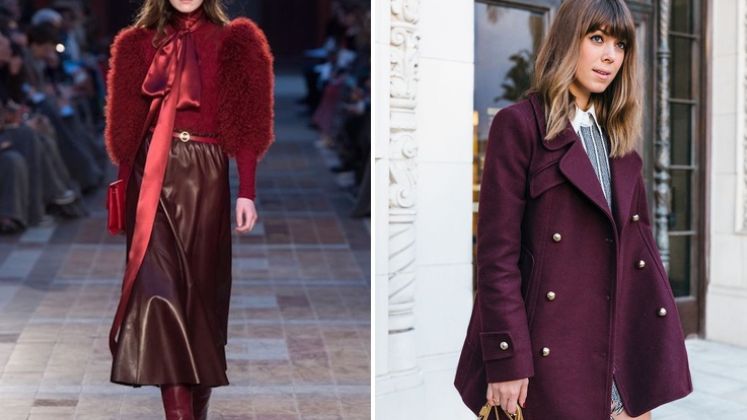
Wine, merlot, burgundy, oxblood, the berry family is emerging as one of the defining palettes of autumn/winter 2026, and its appeal lies in its dual identity. It reads as a genuine colour statement while functioning almost like a neutral, sitting comfortably alongside black, grey, navy and camel, and holding its own against pink, emerald and leopard print.
Berry’s presence on the A/W 2026 runways was widespread rather than confined to one house. Balenciaga, Givenchy and Miu Miu all sent deep wine and berry-toned pieces down the runway this season, and the tone carried through into ready-to-wear collections from Michael Kors and Lanvin. Trend forecasters including WGSN, Pantone and Coloro have flagged deep wine and berry-infused reds as anchor tones for A/W 2026 product assortments, which points to the colour moving well beyond a single-season runway moment and into mainstream retail buying.
The muted, wearable quality of the shade, closer to a stained-glass depth than a bright red is what is expected to drive high-street and mass adoption, across tailoring, knitwear and eveningwear alike.
In Indian fashion, Berry has resurfaced prominently in bridal couture. Sabyasachi’s latest collection brought burgundy back into focus after the tone had receded from recent bridal palettes, positioning it as a regal, winter-wedding-appropriate alternative to the red and pastel lehengas that have dominated in recent seasons. The shade’s depth lends itself naturally to heavy zardozi and Banarasi silk work, where richer tones read as more couture than brighter reds.
At the contemporary and casual end, the palette translates just as fluidly into everyday drape. Suta’s handloom and cotton-silk sarees have carried maroon and wine tones across multiple collections; pieces such as its maroon-and-black “Red Wine And Black Olives” saree and its cotton-silk “August Presence” design use the shade as an everyday, office-to-evening option rather than an occasion-only hue, echoing the “berry as neutral” positioning seen internationally.
For the Indian market, berry’s cross-category flexibility is its biggest commercial advantage. The tone already has deep cultural resonance which gives retailers and D2C labels an easier entry point than seasonal colours with no local precedent. Its ability to move between saree and lehenga silhouettes, structured western-wear tailoring, and knitwear layering pieces makes it a low-risk buy for merchandisers stocking both ethnic and fusion categories ahead of the wedding and festive season. With global forecasters aligning on the same tone, Indian labels from couture houses to accessible D2C sarees and separates, have a rare instance of runway, retail and cultural relevance converging on a single shade for the season ahead.