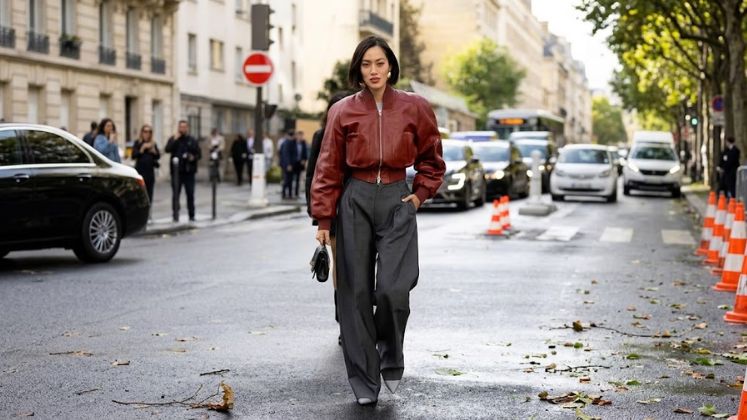
There was a stretch, not too long ago, when the bomber jacket meant sporty, zip-up, ribbed at the cuffs, done. That version hasn’t disappeared, but it’s no longer the only version and that shift is the real story of the bomber’s Fall 2026 comeback. According to stylist and trend consultant Echko, the jacket has diversified in every direction at once, moving through suede and leather, oversized and cropped proportions, and fabrications considerably more elevated than the nylon original it borrowed its shape from. Fashion stylist Andie Sobrato is equally taken with the piece, noting that adding this jacket into the rotation automatically makes any outfit feel cool; less a trend endorsement than a quiet admission that the bomber has become a styling shortcut.
What’s changed isn’t the silhouette so much as what it’s allowed to sit next to. Echko’s own approach leans into contrast deliberately, pairing the jacket with something it wouldn’t obviously go with, like a silk skirt, a slip dress, a pair of sharply tailored trousers, precisely because the friction between utilitarian outerwear and something more fluid is what makes an outfit feel considered rather than default. It’s a styling logic that Indian brands, long comfortable treating the bomber as a layering piece rather than a statement one, are well positioned to run with.
That comfort shows up across the market. Roadster, Myntra’s in-house label, has built one of the largest bomber assortments in the country, spanning the classic nylon zip-up through to heavier, boxier winter versions, proof that the silhouette’s mass appeal in India was never really in question. WROGN, Virat Kohli’s label, and Highlander have both used the bomber as a recurring seasonal anchor, typically in washed cottons and utility fabrications that split the difference between streetwear and smart-casual. HRX, Hrithik Roshan’s activewear line, keeps a more technical, sport-inflected version in rotation, closer to the jacket’s original identity, and a useful reminder that the sporty bomber Echko describes as fading hasn’t actually vanished, just been joined by the company.
Where the jacket’s elevated turn is most visible domestically is in fabrication rather than fit. Numero Uno and Mufti have both introduced faux-leather and suede-finish bombers in recent seasons, tracking the same move toward richer surface treatments seen internationally. Killer and Spykar, both denim-first labels, have used the bomber as a way to extend their fabric vocabulary beyond jeans like denim bombers and quilted versions sit alongside their core ranges as a natural crossover product. Provogue and US Polo Assn India have taken a more classic route, keeping the jacket close to its varsity roots in wool-blend and satin finishes.
The streetwear end of the market has arguably done the most with the silhouette. Bewakoof, Snitch, Campus Sutra and The Souled Store have all treated the bomber as a graphic and colour canvas with oversized fits, bold prints, cropped lengths, mirroring the international push toward more expressive, less uniform versions of the jacket. Being Human Clothing sits somewhere between the two camps, offering both a pared-back essential version and periodic collaborative drops that lean into the trend-driven side of the category.
The bomber’s Fall 2026 relevance isn’t about a single new detail; it’s about range. International labels are stretching the jacket across suede, leather, oversized and cropped territory simultaneously, and Indian brands, from denim-first players like Killer and Spykar to streetwear labels like Bewakoof and Snitch, already have the infrastructure to follow in nearly every direction at once. For a jacket that’s spent years being treated as a single, settled silhouette, that’s the more interesting shift.