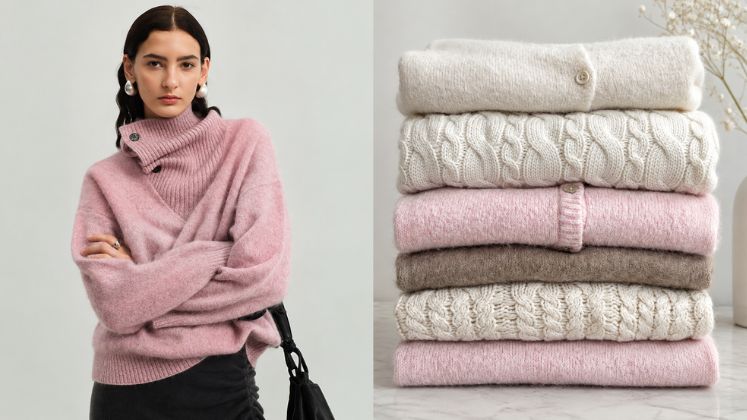
Cashmere is emerging as one of the defining materials of the Fall/Winter 2026 season, prized for its tactile softness and its ability to move between casual and formal dressing without friction. On the international runways, the fibre showed up in multiple registers: The Row worked ribbed cashmere into its collection, while Prada leaned on washed double cashmere alongside cotton poplin and linen for shirts and skirts built around a “purity, simplicity” brief.
COS took a similar material-led approach at New York Fashion Week, cutting double-faced cashmere into enveloping maxi silhouettes and cinched coats with exaggerated collar details. At the more ornate end of the season’s mood, Gabriela Hearst worked hand-crocheted cashmere lace into her Edwardian-referencing designs; a reminder that the fibre is being used as much for texture and craft value as for warmth.
In India, cashmere spans a wide spectrum of labels and products. At the heritage accessories end, Delhi based Mauli Cashmere offers handcrafted, embellished cashmere shawls, stoles and scarves inspired by mythological motifs, alongside capes, throws and cushion covers. Kashmir based Dusala, founded by Sugandha Kedia, works in handwoven cashmere and fine wool stoles, shawls, capes and jackets, often finished with zari embroidery, kani weaving and reversible patterns. Kashmir Loom, established by Jenny Housego and Asaf Ali, produces fine ring shawls and kani and sozni embroidered pashmina pieces for a global clientele, with pieces held in institutions including MoMA. Pashtush offers a more accessible range of wool and cashmere blend stoles, scarves and shawls in classic checks, jacquards and Kalamkari prints. Ladakh focused Kuttons sells 100 percent pure, handspun pashmina cashmere across scarves, wraps, hats, gloves and socks sourced from Changthangi goats. Kullu Karishma, working out of Himachal Pradesh since 1991, produces handknit cashmere and pashmina sweaters and wraps alongside other natural fibre pieces made by village women artisans.
On the ready to wear side, menswear label Andamen has extended its Merino focused Apex collection into pieces such as its cashmere blend pullover, using Woolmark certified yarns.
At the top of the luxury pyramid, Sabyasachi’s Spot The Tiger line has turned 100 percent cashmere sweaters, styled with the house’s Bengal tiger logo, into one of its most talked about recent drops, worn off runway by the designer himself and spotted on figures such as cricketer Hardik Pandya.
Cashmere gives Indian labels a rare overlap between global runway relevance and a genuine domestic material claim, rooted in the country’s role in the Himalayan pashmina supply chain. As international houses push cashmere into everyday layering with ribbed knits, roll-necks, ruanas, rather than treating it as occasion-only, Indian brands with established cashmere ranges are well placed to position these pieces as accessible, transitional staples for the domestic cooler-weather season, rather than purely festive or gifting purchases.