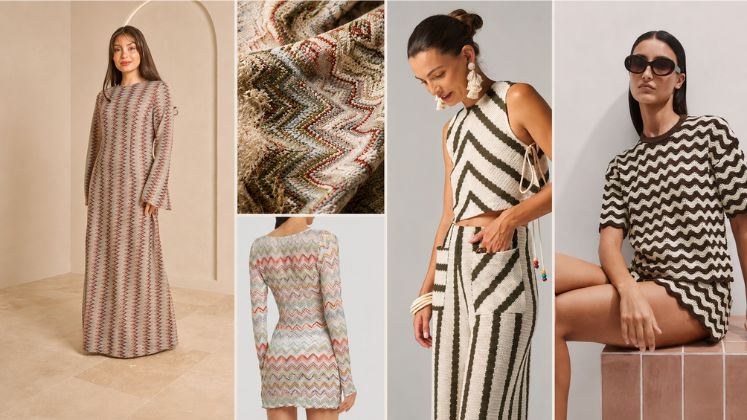
From Chanel’s Paris runway to Rajasthani ateliers, the graphic zigzag sheds its millennial mall-fashion past for architectural sophistication
The chevron print has re-entered high fashion, this time stripped of its candy-coloured, mass-market past for a tailored, textural reinvention.
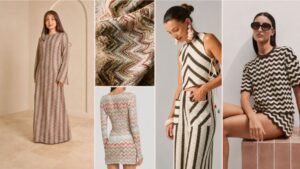
Missoni wove the zigzag through its Fall/Winter 2026 ready-to-wear collection shown in Milan this past February, continuing the house’s long-running signature knit motif. It was also seen on Alexander McQueen’s Autumn Winter 2026 pre-collection; the luxury label worked chevron patterns and wishbone detailing across tailored trousers, collared dresses and its Manta bag, giving the print a polished, structural edge rather than a purely decorative one.
Most recently, at Paris Couture Week, Matthieu Blazy sent Look 46 of Chanel’s Fall 2026 Haute Couture collection down the runway in the house’s signature tweed reworked as a black-and-white chevron coat and dress, a direct, monochrome update of an archival house code.
Trend analysts state chevron is currently fresh enough to read as directional rather than dated, and positioned ahead of mass adoption. What separates this iteration from its 2010s predecessor is texture; designers are rendering the motif in woven bouclé yarns, wool and alpaca rather than the flat, printed cottons and synthetics that defined its last cycle, lending the zigzag a tactile, almost architectural weight.
In India, the pattern is finding an equally deliberate, craft-forward expression. JJ Valaya’s “Shifting Leaves Chevron” line translates the V-shape motif onto luxury Alika jackets, anarkalis and printed sarees, positioning the print within contemporary couture rather than festive prints alone.
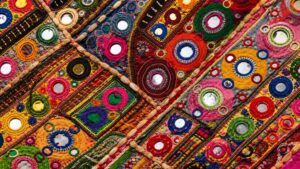
Abhinav Mishra, known for his mirror-work, folds chevron into pastel lehenga sets, including the Magnolia Chevron Pattern Lehenga Set, through delicate embroidery and traditional gota patti work, fusing a graphic modern print with heritage embellishment techniques.
Beyond couture, the motif is surfacing across more accessible categories: leheriya-inspired dupattas and turbans, where the tie-dye technique naturally produces diagonal wave patterns; ikat and bandhani weaves adapted into zigzag borders on silk and cotton; relaxed rayon and cotton-silk kaftans and co-ord sets; and gota patti-embellished hemlines on lehengas and dupattas. Resort and ready-to-wear pieces are leaning on block-printed borders, structural pleating and Pochampally ikat weaving to bring the print into everyday wardrobes.
Rooted variously in architectural inlay work, echoes of the Taj Mahal’s marble patterning are often cited, and Rajasthani leheriya waves, chevron’s return reads less as nostalgia and more as a graphic bridge between heritage craft and contemporary tailoring, built to create visual illusions of height, movement and elegant flow.