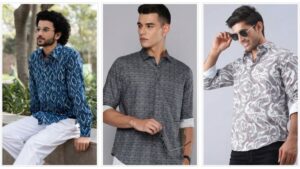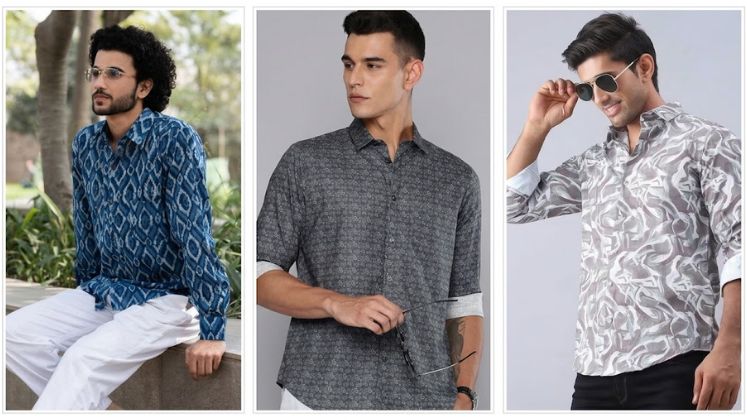
Men’s corporate wear moved beyond navy, black, grey and white some time ago, taking in pinks, maroons, wine and purple. Print and motif are now getting the same enthusiasm. Relaxed workplace codes and hybrid working are bringing colour, texture and Indian craft into the office wardrobe. Tailored trousers, loafers and structured jackets are increasingly paired with textured or patterned shirts rather than the default white one.
The shirt remains the centre of this shift. IMARC estimates that shirts and T-shirts account for 34% of India’s menswear market. Galeries Lafayette Mumbai’s “Shirt Stories” edit, with 4,000 shirts from more than 50 global fashion houses, shows how a single category now covers work, play and indulgence.
The most commercially important direction is restraint. Nicobar, whose nature-inspired motifs and hand-drawn patterns sell well in cotton and linen, finds that micro-geometries, fine stripes and small repeats work best. CEO Rashi Sethia calls the idea “personality without noise.” Thomas Scott reports the same pattern. Micro-prints, meaning small florals and geometrics that read almost as solids from a distance, are its biggest category for work, while larger florals, palms and abstract washes are moving into evening and travel wear, particularly among 25-to-35-year-olds. Rare Rabbit sees interest widening beyond checks and stripes to geometric, tropical, paisley, floral, monogram and art-deco prints.
Indian textile traditions are the second thread. The F.A.R. Store points to growing interest in block prints, subtle embroidery and lighter colours, with Ajrakh and Batik standing out. Co-founder Ritika Jhunjhunwala argues that the change lies less in a desire for boldness and more in a new definition of what makes a shirt distinctive. The Bear House adds interest through weave rather than print, using dobby, slub and Oxford cottons.
Established names are sharpening their craft offer. Fabindia has refreshed its bush shirt for pre-fall in Dabu, Ajrakh, Ikat and hand block prints, and Avishya describes its Ajrakh shirts as premium cotton pieces that bring Kutch block-printing heritage into modern comfort. Both brands therefore sell Ajrakh and ikat shirts in their own right, which clarifies the original article’s wording. Kardo, a New Delhi label founded in 2013, works with handloom weaving communities on natural dyes, block prints, ikat and shibori, and each garment is cut, sewn and finished by a single named tailor. Myntra’s private label Taavi has worked with about 1,300 artisans across seven states and now carries men’s Ajrakh block-printed cotton shirts, including a hand block print version with a Cuban collar.
Block printing also has long-standing institutional players. Anokhi was founded in Jaipur by John and Faith Singh in 1970, when the city’s block printing industry was at a very low ebb, and its range today includes hand block-printed menswear alongside womenswear, childrenswear and home furnishings. Chippa uses dabu, a mud-resist block technique, in cotton, while Aadir uses striped block prints in earthy tones. At the design end, Rajesh Pratap Singh, founded in 1997, has Ajrak prints on linen and handloom ikat weaves held in the Victoria & Albert Museum’s archives. Okhai, a Tata Chemicals-backed social enterprise, has launched a 19-garment Ajrakh collection with artisan designer Mubin Khatri of Dhamadka, Kutch, which includes Ajrakh on cotton twill denim. Tasva, the ABFRL and Tarun Tahiliani label for occasion wear, brought Kutch lippan mud-mirror work into its Lakmé Fashion Week showcase in October 2025, showing craft moving from the office shirt into festive dressing.
Smaller craft platforms round out the picture. Gaatha’s Itr Ajrakh shirt in modal silk is hand block printed by artisan Sufiyan Khatri. Haradhi sells Ajrakh and Jaipur block-print cotton shirts for men in motifs such as elephants, florals, lotus and zig-zags. iTokri offers shirts in Ajrakh, Pochampally ikat, Bagru and Sanganeri prints.
Louder designs have found a home elsewhere. Numero Uno Clothing brings colourful polos, barrel pants and wider, looser jeans and trousers into the mix, while GAP and AZORTE favour bolder graphics and prints in sports and streetwear. The market is sorting print by occasion. Quiet patterns and craft textiles suit the office, and expressive ones suit evenings, travel and the street.
Versatility ties these strands together. The old divide between weekday formals and Friday dressing is fading, and hybrid work has pushed men towards pieces that carry them from meetings to dinner and social occasions. The stiff, tucked-in formal shirt is giving way to relaxed fits and no-crease fabrics, such as Uniqlo’s Super Non-Iron Shirt and AIRism Cotton Pique Polo. A Uniqlo spokesperson says consumers are buying versatile essentials that move between professional and personal settings rather than shopping for a single occasion.
Brands that combine heritage techniques with restrained scale and easy-care fabrics look best placed as print becomes a normal part of the office shirt.