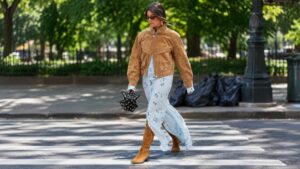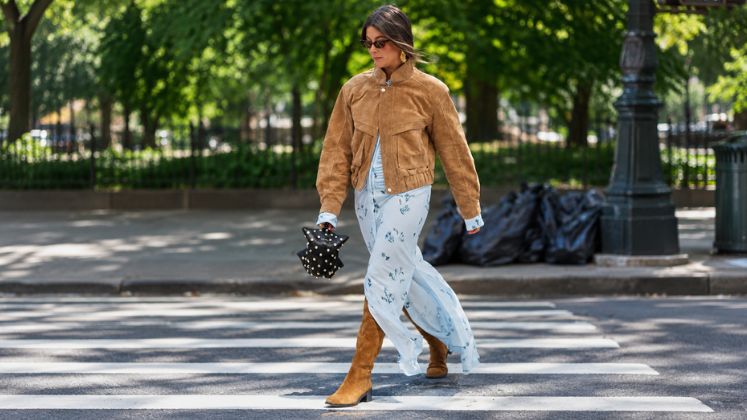
Cowboy boots, prairie blouses and head-to-toe denim have had their moment. As the industry turns toward Fall/Winter 2026, it points to a subtler shift in outerwear: suede and leather moving from statement pieces to wardrobe staples. The appeal of suede lies in a “feeling of richness and complex texture” that doesn’t lock an outfit into one obvious aesthetic, suede layers as easily over denim and a cotton shirt for daytime as it does into an evening look, making it one of the more commercially flexible materials brands can build around this season.
True suede is split leather; the fibrous underside of a hide (lamb, goat or calf), buffed to raise its nap, making it lighter and more pliable than full-grain leather but more porous and harder to weatherproof. Nubuck, by contrast, is full-grain leather sanded on the outer surface, giving it a finer nap and greater durability than true suede. Faux suede is a polyester or polyester-polyurethane microfibre built to mimic the brushed texture without hide, trading longevity for wash-and-wear resilience and a lower price point.
The runway data backs this up. At the Autumn/Winter 2025 shows, Coach worked longline suede coats in caramel tones, Hermès pared its outerwear down to minimalist suede jackets, and Miu Miu reworked the bomber into a boxier silhouette — a direction that carried into Spring/Summer 2026, where Tod’s sent suede trench coats down the runway, signalling suede’s move beyond a strictly cold-weather material. For Fall/Winter 2026, the oversized leather jacket has emerged as one of the most discussed pieces across the season’s shows, from Saint Laurent’s roomy silhouettes to Chanel’s classic biker and Tom Ford’s sharper crop, with suede positioned as the softer alternative within that same trend. Colour has shifted away from black-dominant palettes toward chocolate brown, cognac, tan and olive, and fast fashion has followed: Zara has introduced suede pieces into its fall offering, a reliable signal of a texture moving into the mainstream.
Suede’s mainstream western resurgence maps onto Indian retail differently, given the country’s shorter, milder winter window. Rather than committing to full suede garments, Indian brands are adopting the material as a considered accent. Leather and suede specialist Hidesign has expanded suede across its bag and small-leather-goods lines this season, while accessories label Da Milano folded “supple suede” into its Spring Summer ’26 collection alongside raffia and patent leather, in warm, sun-baked neutrals. On the apparel side, menswear label Bhaane has used suede detailing on jacket collars and pocket trims for its transitional-season pieces — a lower-risk way to work the texture into pieces suited to India’s brief cold months — while designer Ritu Kumar’s recent occasionwear collections have leaned on suede-like textures in structured jackets. Across the market, the pattern is consistent: suede as premiumisation tool on trims, panels and accessories rather than as a core apparel fabric, extending naturally from brands already working in leather while giving apparel labels a way to participate without inventory risk. At the accessible end, the category is also opening up through faux-suede outerwear; pieces like PrettyGarden’s cropped faux suede jacket illustrate how the look is being replicated at mass-market price points using vegan alternatives, widening suede’s reach beyond the premium and luxury segments that have driven it so far.
For Indian brands, suede’s Fall 2026 momentum is arriving as a trim-and-accent story rather than a full-fabric commitment, which suits both the market’s shorter winter cycle and its cost-sensitive middle segment. Accessories-led players such as Hidesign and Da Milano are best positioned to capture the trend directly, given suede’s existing role in bags and small leather goods. For apparel and outerwear labels, the opportunity lies in using suede detailing like in collars, trims, panels,as a premiumisation lever on transitional-season pieces, rather than betting on suede as a standalone category the way Western markets can. The faux-suede segment, meanwhile, gives value and mid-market labels a way to participate in the same textural mood without the climate and cost constraints of genuine hide, suggesting the trend’s broadest commercial impact in India may ultimately be felt through accessible, vegan interpretations rather than premium leather goods alone.