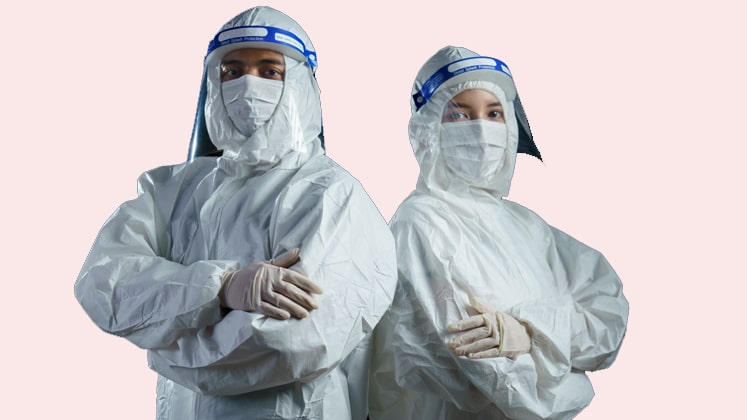
The world of business is full of hazards and millions of people are exposed to it on a daily basis. Though crucial sectors like automobile, steel, gas and chemical can be seen taking necessary precautions to safeguard its people, the textile industry traditionally has been on relatively low exposure to hazards. And hence, when the textile industry has to provide hazard solutions, it is difficult to believe that the textile manufacturers are fully geared up to provide the medical industry with a highly sensitive and technical product like body coverall which needs immense efforts that go into fabric engineering, manufacturing process, seam sealing techniques and sterilisation for which the industry, unfortunately, is not habitual in its entirety.
Also Read: What goes into making a body coverall?
Avinash Misar, Director and CEO, Advanced Material Division, Texport Syndicate (India) Ltd. and Director, Indian Tech Textiles Association, in a freewheeling conversation with Apparel Resources, touched upon some sensitive aspects to bring out body coverall manufacturing process in a larger and clearer perspective. Here are some of the issues and the possible solutions for new entrants in PPE manufacturing, especially for medical textiles.
Issue 1: Understanding of fabric engineering still remains a challenge for the industry…
The current pandemic evoked an unprecedented surge of PPE requirements, therefore infusing a hyper overnight manufacturing activity to serve the cause. However, it should be understood by the textile and apparel industry that a meticulous approach is needed due to the technology involved in a highly technical product like body coverall. Indian manufacturers didn’t get time to adjust with the situation and it’s seen that ASTM F 1670 testing parameter for fabric has been widely adopted which is simply a synthetic blood penetration test. But, for better value preposition, ASTM F 1671 standard should also be taken into consideration, something which is not just blood penetration test but a viral penetration test.
Secondly, it has been observed that people are also using Spunbond Meltblown Spunbond fabric, commonly known as SMS, with PE lamination which is a disaster, as it has no breathability and would sweat out a health worker. The companies are sending it for testing and getting approval. “I wouldn’t want to make a loud statement but it is truth that the above combination is commonly used as industrial packaging fabric,” insisted Avinash.

As technical textile is already a focused subject matter of Texport Syndicate – through its Advanced Material Division (AMD) – the company claims to have an upper hand in right fabric identification for medical textiles. It is sourcing SMS tri laminated fabric from one of the most eminent PPE fabric manufacturers in India which is approved for synthetic blood penetration test and best product even to meet viral penetration test.
Also Watch: Apparel Resources’ Webinar on ‘Challenges of Making of PPE: Body Coverall’
Issue 2: Breathability in coverall fabric should be considered as a crucial aspect which is, as of now, not the case
Breathability of a body coverall entirely depends on how you treat the fabric. Technical textile is nothing but the textile with added principle of performance desired through materials. Coating and lamination are two major processes which become big differentiators in taking a normal fabric to a level of performance fabric in order to achieve breathability at the same time, be impermeable to blood and other liquids. The various chemistry work upon in these processes and that’s where the whole equation of breathability lies. The generic process of lamination looks like a simple process where a film is laminated on fabric using a hot roll and by applying a certain amount of pressure. But the key goes into the film, as it’s necessary to have a technical understanding of the kind of film being used, the porosity of film, performance the film will deliver and the processes which a manufacturer will adopt so that the film doesn’t get distorted and the desired result is achieved. The same phenomenon goes with the coating process.
“Now people think that coating is a simple thing, but it is not. One of the fabrics, which we developed for a large multinational brand, has water resistance to 10-12 metres of water column and yet breathable. This fabric stands at 12 metres of water column. Due to this, water will not pass through the fabric, but air will pass. So when we talk about breathability, it’s still a manageable game, but a lot of people are not able to give breathability because their chosen fabric is practically non-porus from the other side which has a PE layer,” Avinash highlighted a major issue here.
Breathability in coverall fabric is achieved when there is microporous structure in fabric and the manufacturer has engineered it that way. And the structure should be made in such a way that the fabric must not allow water to permeate, but it will allow air to permeate. These are the important aspects of coating technology and coating chemistry to achieve breathability which should be well-known to manufacturers before venturing into coverall manufacturing.
“We are expanding into various laminating and coating technologies, which is an interesting zone with all anti-microbial, anti-viral solutions in addition to breathability, and that’s how one should cater to a highly challenging product like body coverall for Med Tex,” informed Avinash.
Texport Syndicate AMD has invested in a state-of-the-art Innovation Centre in Mumbai with pilot machines facility to continually upgrade its technology and to provide various solutions to the industry. This is headed by its Vice President (Innovation & Technology) Narendra Kajale who comes in with a rich experience of 25 years in the field.
Issue 3: Seam sealing and tape attaching processes are more critical than they seem
The biggest issue here is the cost. As apparel industry is already a price-sensitive industry when it comes to the technology adoption, the case is not quite different here in coverall manufacturing as well. Control mechanism in seam sealing machine is the most significant, but unfortunately, to start with coverall manufacturing in a hurry, manufacturers are losing grounds. There are seam sealing machines available in the market ranging from US $ 3,000 to US $ 10,000 or even more. The low cost machines do have hot air blow, with less control on the process, with which a certain amount of pressure is applied on the film and the operator can get the seam sealed. Now while the process is done on these low cost machines, the reliability is low as these machines do not have speed sensor, curing sensors, auto feed, start-up sensors, etc. Seam sealing has to be done straight and in one go with perfect pressure, temperature and speed, and there should be an effective machine control mechanism which is required. This problem does not occur in relatively high cost precise machines.
“When you talk about basic things to be done, blowing up the hot air, giving a stretch and applying adequate pressure are the parameters present in a generic machine also. But the finer control parameters are available in high-end machines,” asserted Avinash.
On the other hand, the selection of sealing tape is an important parameter of the whole process. It’s a fact that the understanding of right tape to seal the seam is quite low in the early days of coverall manufacturing in India and most of the manufacturers confuse it with the normal adhesive tapes. Tapes are not just used in coveralls, as there are hundreds of other applications as well, so it becomes imperative to select the right tape. A deep study is required and once the tape selection is done, comes the bonding of the same on seams. The operators generally do not complete the total taping length in one go, rather they stop, readjust, regrasp the material and continue taping which is not at all recommended. The point where machine stops gets low temperature distribution on tape and it remains unheated, therefore doesn’t get pasted properly. This is where the manufacturers lose the quality and become unreliable in process, risking lives of medical professionals who are going to wear these coveralls.
“It is also seen that people use cold process of pasting tapes on seams. This depends completely on what the customer wants, but technically it is not appreciated,” concluded Avinash.






 Bharat Tex Special Report 2026