The e-commerce industry is growing rapidly with new stores popping up daily and offline retailers too expanding in the digital domain. According to etailinsights, in 2022, there are over 9.1 million online retailers globally and 2.5 million in the US alone. With digital platform being overcrowded with both the already existing online retailers and the new entrants of offline retailers, the competition has doubled for players to survive successfully. It is hence imperative for them to reduce the market time to make a product available to the customers and also provide the correct information. Managing multiple marketplaces manually and individually can be challenging, as every platform has its own standards of attributes and requirements.
Technology makes catalogue management easier for brands!
- Simplifying product catalogue management through Vin Lister by Vinculum
Vinculum is a global software company which enables selling on global marketplaces, inventory and order management, omnichannel retailing, warehousing and fulfilment and automated catalogue listing. The Vin Lister solution by the company helps in product listing across more than 20 marketplaces in less than 5 minutes. The sellers are required to fill an excel sheet describing their products with attributes including SKU, price points and images. Once the sheet is filled, it is validated by the respective companies before being pushed directly to marketplace feeds.
“The solution, encapsulated with artificial intelligence (AI), helps in auto publishing of the catalogue to multiple marketplaces across the globe. It works on single input, multiple output algorithms that save a lot of time and help launch the online store quickly by reducing redundant efforts,” said Sachin Jain, Product Manager, Vinculum.
The other feature that the solution offers is transformation of images. It eliminates the need for resizing the images as per different guidelines of different marketplaces. Vin Lister enables automated image conversion to marketplace dimensions as per channel-specific size and resolution besides storing images on channel-specific repository. The other functions of the solution include mapping of client’s product data as per attributes, immediate price change as per marketplace-specific requirements as each marketplace has a different set of customer base.
Vin Lister is integrated with all the major marketplaces of different countries like Singapore, Indonesia, Philippines, Thailand, Malaysia and the USA. In India, the solution is integrated with Amazon, Flipkart, Myntra, Paytm, TataCliq and Ajio. It allows retailers to have presence on all the major platforms while reducing the complexities of managing operations and automating the catalogue uploading process to reduce it to 3-5 days from a month’s duration.
- Pixyle.ai – A Dutch technology company pioneering in automatic product tagging
As a standard process, a catalogue should provide information such as product’s names, categories, price, brand, colour, suppliers and other relevant information. These tag categories need to be accurately ordered in order to make it easy for customers to find the right product.
“Unfortunately, brands and retailers have been using human workforce to fill this information manually since beginning which otherwise could have been used for value-added jobs. Pixyle.ai’s technology eliminates this manual job and enhances product searches on e-commerce,” commented Svetlana Kordumova, CEO, Pixyle while talking to Team Apparel Resources.
Searching is often the first thing website/app visitors do when they visit a fashion e-commerce platform. If the information attached to the products is incorrect, the search engine will display the wrong results. Displaying wrong results can make the visitor leave immediately. What is more, customers often aren’t very precise in their searches, so the search engine has to be very smart in order to find what they really mean.
According to Svetlana, incorrect search results can also lead to more returns, since what people found and ordered might be different from the tagged data associated with it.
Svetlana further explains that the process of AI system of Pixyle works in a way that it scans the image and detects features that are connected to particular keywords. Automatic tagging is a trained AI system that can recognise clothing in images as humans do. “For humans, it takes only a glimpse of an image to recognise a clothing item to decide what it is – a dress, a blouse or jeans. For computers, this is not an easy task as it understands only in pixels, and that is why a large part of inventory management is done by humans. That’s where we have come in,” said Svetlana.
In order for AI systems and computer vision-based processes to recognise if a fashion item is in an image, they need to learn from a lot of images on how clothing and apparel look like, and what attributes can be used to describe them and that’s what Pixyle AI-based image recognition system does.
“The accuracy rate of our technology is over 93 per cent. It can automatically tag 336,000 images in a day that is over a hundred times more than a human can.”
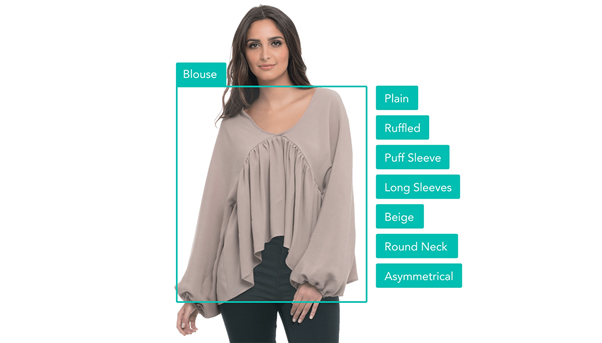
Products don’t have only one tag. In fact, they can have many different fashion tags, as mentioned by Svetlana. For example, an image of a beige blouse (Image 1 shown below) can have several fashion tags attached by the machine learning technology – beige blouse, plain blouse, slim-fit, long-sleeve, puff sleeve, round neck blouse, etc. Even though the shopper might only remember to look for a blue shirt, the AI technology takes all product descriptions and feature specifications into consideration. This allows people who are looking for a blue shirt or a slim-fit shirt to find the same shirt in the product catalogue.