As the COVID-19 pandemic took over the world shutting hundreds and thousands of retail stores and malls across countries, the businesses are quite unsure of what the new normal will look like for them and for their consumers. Apart from creating an overwhelming sense of caution, fear and concern, it has also impacted the consumer sentiments, ultimately leading to loss in business for fashion retailers not only in India, but the world over. According to Confederation of All India Traders (CAIT), ever since the lockdown was imposed on 24 March, the Indian retail sector has lost approximately Rs. 5.50 lakh crore and is likely to witness at least 20 per cent of Indian retailers collapsing and winding up their businesses in the next few months.
Also Read: Inventory glut due to COVID-19: Apparel retail industry looks for the best way out
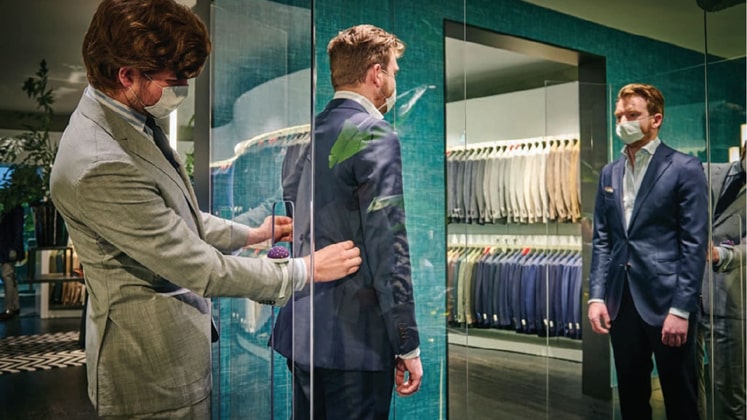
The change in consumer behaviour is permanent and now the retail stores will need to take this new behaviour into account while reopening their stores and no retailer can think of starting from where they left off. If retail brands as well as shopping centres are to bounce back after the lockdown lifts, it will only be through establishing experiential premises wherein the consumers can trust the safety and precautionary measures at the outlet or in the mall. This will instill confidence in consumers that would help them come back and accept the new normal of the retail and shopping. While it was touch and feel that ruled offline retail until the COVID-19 hit the world, the new mantra is touch as little as necessary and sanitise when you do. What will ease the consumers will be the sight of wipe-down stations near trolley stands, store staff wearing gloves and face masks, ‘no handling’ signs on shelves and plexiglasses separating the cash counters, etc. from consumers, among other things.
A staggered reopening process
In order to maximise their potential when they reopen post the lockdown period, retailers would be required to factor in all the possibilities and realities of the world post this pandemic while taking into perspective the trends that worked for the re-emerging markets like US or China, so as to help them thrive in what will be the ‘new normal’. Apparel retail brands are still reassessing how many stores they need to open and in what areas to cater to maximum number of consumers. The overall fashion retail industry is looking at store rationalisation while resuming operations in a staggered way even as the Ministry of Home Affairs has given considerable relaxations even in red zones during the fourth phase of the lockdown.

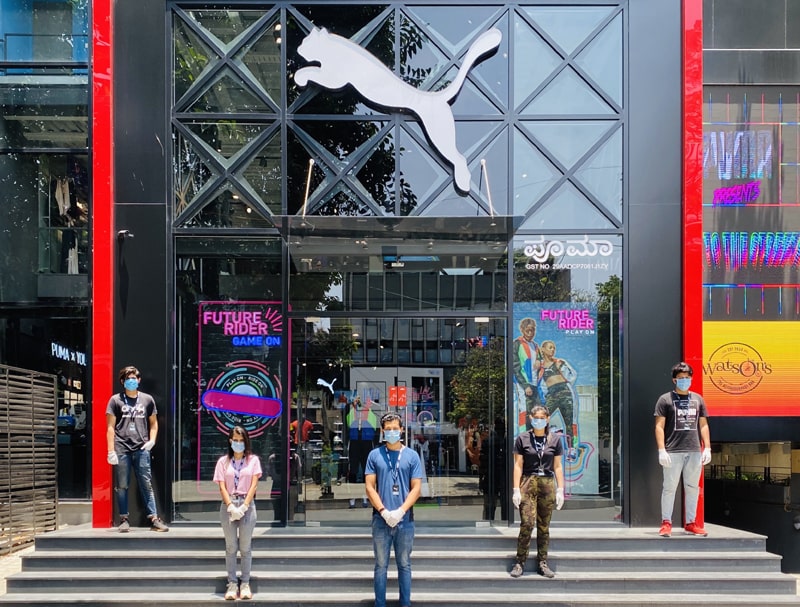
“At Puma, we are following Government guidelines to reopen select standalone stores across green and orange zones. We have ramped up safety measures and are maintaining the required hygiene and safety standard operating procedures across all our facilities,” asserts Abhishek Ganguly, General Manager – Southeast Asia and India, Puma. While the brands are slowly resuming operations in a structured manner, they opine that every step will be taken in accordance to the Government guidelines after following all safety protocols.
Also Read: Fashion retail industry strategises to move from survival to revival post COVID-19
The look and feel of the ‘new normal’ at retail stores
Besides, social distancing norms and minimum contact and hygiene measures, retail brands are gearing up for business and are working on reopening the retail stores with all precautionary measures. Retail stores will not look the same as they used to before the pandemic hit the country and the world. Unlike the earlier times, retailers will now be trying to reduce the time that consumers spend in the stores in order for others to enter while many will also impose restrictions on freely touching clothes or other products.
With no information on when the shopping malls will start operations and in line with the fact that high street stores generate higher sales conversions in comparison to the former (70:30 conversion in favour of high street stores), Bestseller India has opened its high street outlets in Bengaluru, Goa, Chandigarh and few other cities, with adequate precautionary measures in place.
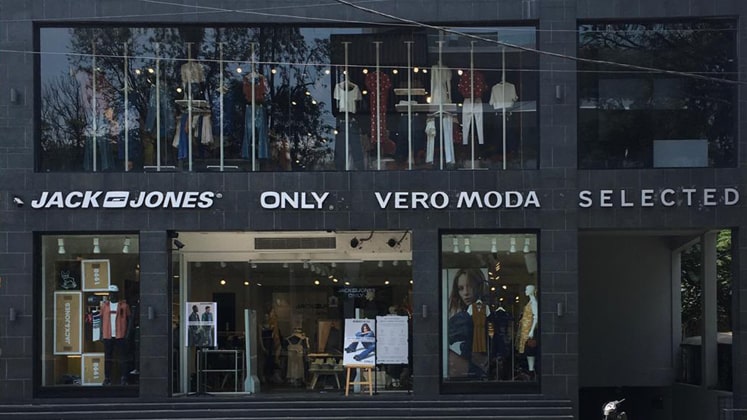
“We are thoroughly sanitising the stores before opening and multiple times during the day, all trial rooms are sanitised before and after use, ensuring every garment is steam sanitised before and after trials; not only that, garments tried are also quarantined in one room for 24 hours before putting them back on the floor. We’re encouraging contactless payments. Wearing masks and sanitising hands before entering the store is mandatory, we’re practicing safe distancing, regularly sanitising all touch points like cash tills and keyboards and daily temperature checks are also mandatory for the staff and consumers. We are also limiting the number of people entering the store at any given point in time, depending on the size of the store. We are doing everything in our power to ensure that our staff and customers stay safe. And while we are doing everything to ensure safe and convenient shopping experience, our customers will also have to do their bit,” explains Vineet Gautam, Chief Executive Officer, Bestseller India. Retail brands are also training their staff to ensure social distancing and that hygiene norms are followed.
Brand in the likes of US Polo, Gap and Aeropostale among others are also shutting their trial rooms as part of their safety measures in the wake of coronavirus. While others are still offering the most important service of offline retail, that is, trials, but definitely with precautions. Siddharth Bindra, Managing Director, Biba, avers, “The option of trial is there for anyone who feels comfortable doing so. Trial rooms will be sanitised before and after every use. The garments that have been tried will be kept in a separate room and left for 24 hours and will be steam ironed post that.”

The industry unanimously opines that hygiene and safety are of paramount importance going forward and how people perceive brands will depend on the hygiene measures adopted in the retail environment. “The new normal will see hygiene, safety and decontamination become a part and parcel of our business process. Our customers want an assurance, and this will be expected going forward. We are maintaining high levels of hygiene standards across all our facilities. At our stores, trial rooms, door knobs and hangers are sanitised at regular intervals. We have stopped providing reusable socks for footwear trials. We are giving out a fresh pair of trial sock for every customer who wants to try on footwear. Currently, customers have not expressed the need to try on apparel. Even when they do, the products will be decontaminated,” maintains Abhishek Ganguly.
Also Read: Start-ups strategising to embrace the ‘new normal’
While large and small retailers launched omnichannel initiatives to facilitate retail for consumers with even mom-and-pop stores offering contactless curbside pick-up, appointment-based shopping will become the new norm in the coming days and shops will have to work around it. Vineet Gautam asserts, “The future of this model is probably uncertain, but in the current scenario, this model presents a fantastic opportunity for retailers because a customer is coming with a clear intent to buy, so the conversion rate definitely goes up. Additionally, this model also ensures a safe and convenient shopping experience to the customers and the store staff.” In the current situation where it is difficult to define the new normal, retail brands are trying every aspect of retail which can ensure consumers a safe and convenient shopping experience.
Experts also opine that there will be adoption of what is called dark stores in retail in the times to come. Dark stores are essentially retail stores, minus the customers walking inside the aisles. The shoppers are able to browse through the stores across different online media and applications which offer a near real-time view of the shelf. Dark stores serve as mid-size local warehouses for storing, sorting and handling orders. Designed to facilitate quick and cost-effective picking, they are easier to automate and can support both click and collection services as well as last mile delivery.
Acceleration of technology adoption
While hygienic measures are one part and quite a major part of the new normal the retail industry is heading towards, technological adoption too commands quite a chunk of the attention and importance, and adoption of omnichannel is one significant move in this direction. Currently, 95 per cent of Indian retail sales happen at physical stores and online contributes to only 5 per cent, and this is expected to change dramatically to breach the double-digit mark within the next 12-18 months.
The need to stay away from each other during the ongoing pandemic has made the industry think and use technology that was previously targeted at solving a different problem – convenience – to offering an altogether different advantage of lower interaction between people, products and infrastructure. Retailers are now increasingly looking at implementing contactless and mobile payments for transactions in order to avoid touch as much as possible. Furthermore, the generational gap around the adoption of technology is shrinking with both baby boomers and Gen Z becoming more comfortable with technological advancements today.
Siddharth Bindra maintains, “This is the time to innovate and move to the digital space very quickly. We are working on some at our end too. Digital payment methods are already in use.” While the fashion retail industry is still in the early stage of restarting operations, the retail brands are aware that consumers will want experience more than ever and there will be all the more need for the adoption of VR and AR to create that 3-dimensional layer.
For starters, technology around payments will be the key as the process needs to be as seamless as possible. Contactless payment options can range from QR codes and mobile payments to NFC and tap-and-go technologies. Insync Shop Fittings, which prides in offering shop fittings for the best of retail experience, is working on and is developing solutions that would help retail brands navigate through the new normal.
“Besides offering touchless sanitiser dispenser, we are working on offering solutions for the retail brands, as they are preparing to reopen stores in the coming months. One of the biggest challenges for offline retail brands is feasibility of trial rooms. There is a need for technology that would enable the retail brands to disinfect the tried garments easily and there is a technology being tested on in the US around this. Furthermore, technology would be looked upon for offering customers with maximum information without interacting with the store staff. Retailers would need technology where they can to provide information about merchandise on their own displayed on a screen without any interaction with any of the staff. We, at Insync, have developed this technology which is available for retailers to buy. Also, the coming days will witness a considerably reduced footfall in shopping malls which would make it difficult to justify the store space by the retailers at the malls. We have created a pop-up module that can very easily be put up and dismantled and has integrated lighting. The pop-up features digital displays for people to browse through the collection. We can also integrate POS system in the racks for better convenience,” says Huzefa Merchant, Founder, Insync Shop Fittings.
Rethinking shopping centres
While the shopping malls are yet to get a go ahead to start operations after a directive on the opening hours from the Government, the coming days will require them to reinvent themselves. Currently, Delhi’s leading shopping centre Select CITYWALK is open for only essential services like groceries and pharmacies and is working on strategies to start operations in the coming future.
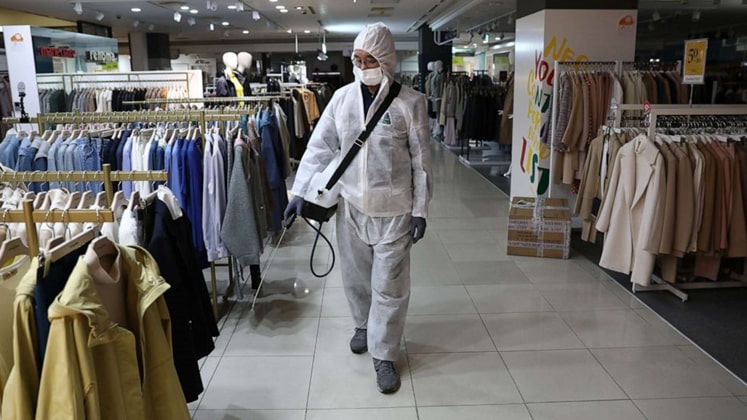
“As a responsible public space, Select CITYWALK will be taking stringent measures post-opening to ensure social distancing and safety practices for all visitors. The measures have been drawn up in accordance with the Ministry of Health guidelines. Entry points will allow visitors to practice social distancing with designated markers, which will help people keep recommended 3-meter distance. The manual frisking will also be replaced at entry points and thermal scanning will be introduced. Hand sanitisers will also be made available. To ensure social distancing in lifts, Select CITYWALK will be only allowing limited passengers in elevators. There will be restrictions on movement on escalators as well, with passengers only being allowed to use every third step. All touchpoints at escalators will be disinfected every hour. All special areas and washrooms across the premises of the mall will be following stringent disinfecting measures,” informs a Select CITYWALK spokesperson while talking to Apparel Resources.
The mall is also working with technology partners to provide a solution for F&B ordering and payment without interaction. The shopping centre is also preparing a visitor handbook with guidelines for them to maintain social distancing and safe practices in a public space. Meanwhile, other shopping malls too are strategising well in time in order to stay prepared for when the Government allows them to start operations.
The times ahead
Moving forward, rethought store designs will reconceptualise how bricks-and-mortar stores serve multiple purposes of consumers. The stores will move from trying to attract more and more consumers at a given point in time to trying to minimise the number of people inside the outlet at a time or even resorting to appointment-based shopping.
Extreme ambiguities signify the gravity of the current crisis as to how and when it will end, but there will be gradual and not steep recovery in the months to come. The current technological lean and adoption of more sustainable business model might help the overall retail industry emerge stronger with a good foothold on technology.
While there is uncertainty on when consumers will start coming back to offline retail stores, Abhishek Ganguly avers, “Consumers have already started embracing the new normal. On the first day of reopening our stores, we saw a very positive response. There has been a sense of cheer among consumers, as they are seeing this as a first step towards getting back to normal life. Consumers have been very appreciative of the efforts being undertaken and are willing to cooperate to ensure SOPs are followed.”
Also Read: Marketing a fashion brand successfully in times of COVID-19





 Bharat Tex Special Report 2026