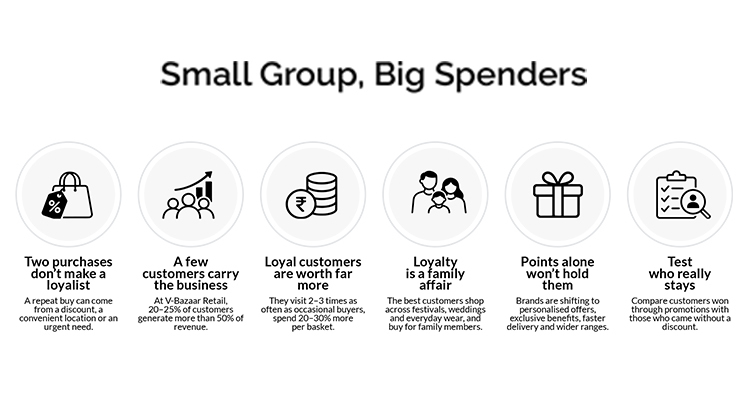
A customer buying from a brand twice does not necessarily make them loyal. They may have returned because of a discount, a convenient location or an immediate need. The real test is whether they continue to choose the brand when other options are available, across seasons, occasions and changing wardrobe needs. As consumers become more informed and have more brands to choose from, businesses are having to work harder to turn individual purchases into lasting relationships.

“Loyalty, to us, is not simply someone buying twice. It is the customer who returns across occasions and across seasons, who brings the next generation of the family to the brand, and who chooses BIBA when every other option is in front of her,” said Siddharth Bindra, Managing Director, BIBA, an ethnic wear brand.

V-Bazaar, too, sees loyalty extending to the customer’s family. “A loyal customer is really a loyal family. They come for festival shopping, again for a wedding, and then for everyday clothing. Over time, they start buying for more people at home,” stated Raghav Agarwal, Director, V-Bazaar Retail, a value retailer that currently operates 130 stores in over 100 cities.”
He added, “Two customers can spend the same amount in a year, but one buys only during a sale while the other shops across occasions. That does not make the sale customer any less important. We need to understand the different buying patterns.”
The commercial contribution of loyal customers can be substantial. At V-Bazaar, roughly 20–25% of customers generate more than 50% of revenue. They visit around two to three times as often as occasional buyers, spend approximately 20–30% more per basket and have a lifetime value around three to four times higher.
Building Loyalty Beyond the First Purchase
With consumers exposed to more competing brands, businesses will need to give customers fresh reasons to return over the next three to five years. Personalisation, convenience and a wider range of relevant products are likely to play a greater role, while loyalty programmes will need to move beyond points and discounts to offer benefits that customers actually value. Raghav said most shopping in the towns it serves starts with a need and a family budget. Price matters, but so does finishing the shopping in one place, and a family that finds what it needs for several people in one value that convenience. “An offer may get the first visit, but there has to be another reason for the next one,” he said. If shoppers came because it was convenient, the retailer has to maintain that convenience.
BIBA is also expanding its range to cater to women across different occasions and age groups. Along with everyday Indianwear and festive and wedding collections, it offers modern fusion styles through BIBA NXT, a sub-brand aimed at Gen Z and young millennials, with prices ranging from ₹899 to ₹1,999. BIBA Girls offers ethnic and western wear for children. The brand is also strengthening its loyalty programme and using customer data to make its communication and offers more personalised.

Similarly, Madhu Sudan Pahwa, Chairperson & MD, Womancart, which operates ShopFaeezah, an online brand for ethnic and modern women’s apparel, believes loyalty programmes need to offer more than reward points. They should include exclusive benefits, personalised messages and relevant offers, along with faster delivery and easier product discovery. “The key is to ensure that rewards remain meaningful to consumers while being commercially sustainable for the business,” he said.
Retaining existing customers can also improve the economics of digital commerce, where acquiring new buyers can be expensive. Madhu cites a benefit of around 5–15% over time as an illustrative benchmark for some loyalty programmes, although actual savings depend on the programme structure, shopping frequency and benefits offered.

A good way to test loyalty, Sumedha Jain, Marcomm Head, Madame, a fast fashion brand for women, explained, is to compare customers who joined through a promotional campaign with those who came without a discount. “We look at how often each group buys again, how much they spend per purchase, whether they pay full price and what it costs to win them over. This shows whether a campaign created a quick bump in sales or customers who stay with the brand.”
Winning new customers and keeping existing ones, she said, should be seen as two investments that work together. The cost of winning a customer is the money spent on acquisition divided by the number of new customers gained in the same period. The cost of keeping customers needs a clear scope, covering what is spent on existing buyers, including CRM and promotions.