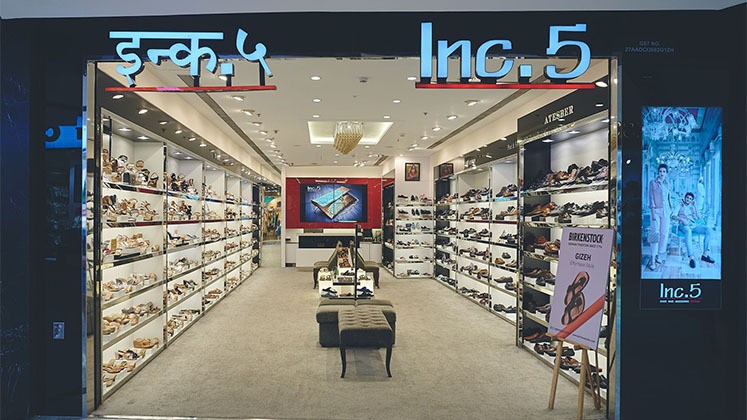
Homegrown footwear brand Inc.5 is aiming to reach 100 standalone, company-operated stores by April this fiscal and is stepping up investments in digital capabilities, technology integration, and omnichannel infrastructure, according to Managing Director Amin Virji.
The brand currently operates around 92 standalone stores across 46–47 Indian cities, all fully company-run. Virji noted that Inc.5 has opened 35–38 stores over the past three years and intends to scale up to 120 stores by the end of the next fiscal. He said the company’s primary focus remains on metros and Tier-1 markets, where it continues to see strong potential, while it is simultaneously expanding into Tier-2 cities such as Indore, Udaipur, Surat, Goa, and additional locations in Ahmedabad and Surat.
Around 70–72% of Inc.5’s stores are mall-based. Virji said malls offer organic walk-ins and faster maturity, while high streets typically demand greater marketing and brand investment, making malls the preferred format. The average store spans 1,150–1,200 sq.ft., with capital expenditure ranging between Rs. 1.1 crore (US $ 122,000) and Rs. 1.3 crore (US $ 144,000) depending on location and size.
In addition to standalone stores, the brand has a strong presence through shop-in-shops (SIS) in large-format multibrand retailers such as Shoppers Stop, Lifestyle, and Central. Inc.5 currently operates around 240–242 SIS counters, a number that grows organically as partner retailers expand. Virji said the company typically adds 10–20 SIS locations each year.
Geographically, the brand is more concentrated in the West, followed by the South, North, and East. Virji said that the West and South together contribute around 55–60% of revenue, with the remainder split equally between the North and East.
Online channels, including the brand’s D2C website and marketplaces, contribute around 20% of overall revenue, while offline stores make up the remaining 80%. Inc.5 offers 3,000–3,500 SKUs online, including marketplace-specific ranges, compared with 1,100–1,200 SKUs per offline store. Women’s footwear accounts for roughly 75% of total sales, with the remaining 25% coming from men’s footwear and third-party brands.




 Bharat Tex Special Report 2026