 India’s influencer marketing industry is expected to surpass Rs. 4,500–5,000 crore (US $467 million – US $519 million) by the end of 2026, up sharply from Rs. 3,000–3,500 crore (US $311 million – US $363 million) in 2025, according to a recent report by influencer marketing platform Kofluence. The report highlights a major shift in the country’s creator economy, with regional influencers, vernacular content and short-form video emerging as the primary growth drivers.
The study noted that brands are increasingly moving away from high-cost celebrity endorsements and instead favouring long-term partnerships with micro and macro creators who offer stronger audience engagement and better conversion rates. According to the report, creators with highly engaged niche audiences in smaller cities are now delivering greater value to brands than large metropolitan celebrity influencers.
Kofluence stated that Tier-3 and Tier-4 cities have become the “centre of gravity” for influencer marketing in India. These markets now account for 43%–48% of all influencer campaigns, generating engagement rates of 4.5%–5.5%, significantly higher than the 3–4% engagement typically seen in metro markets.
The report added that influencer campaigns in smaller cities are also considerably more cost-effective, with campaign costs ranging between Rs. 35,000 (US $363) and Rs. 90,000 (US $934) compared to Rs. 3.8 lakh (US $3945) to Rs. 4.5 lakh (US $4672) in metropolitan regions. Tier-2 cities are also emerging as an important growth layer, contributing 3%–5% of campaigns while offering competitive engagement rates at lower costs.
The language landscape of influencer marketing is also evolving rapidly. More than 62% of creators reported receiving a higher number of vernacular-language campaign briefs from brands, reflecting marketers’ efforts to expand beyond English-speaking audiences. According to the survey, 68.2% of creators primarily produce content in Hindi, while 23.9% create content in regional languages, underlining the growing importance of hyperlocal storytelling and regional consumer connect.
The report further observed that India’s creator ecosystem continues to remain heavily dependent on global digital platforms. Despite the emergence of domestic short-video applications, 77.6% of creators surveyed said they were not active on any Indian short-form video platform. Instagram and YouTube continue to dominate creator engagement and monetisation.
Short-form video has emerged as the most commercially viable content format, with 84.5% of creators identifying it as their highest-earning category. The report noted that short-form video content has effectively replaced television consumption among younger audiences outside metropolitan markets.
Among industry verticals, e-commerce remains the largest spender in influencer marketing, accounting for a 23% market share and estimated spending of Rs. 1,000–1,200 crore (US $103 million – US $124 million) during 2025–26. The report attributed this growth to rising quick commerce integrations and creator-led commerce formats. Typical influencer-led e-commerce campaigns currently cost brands between Rs. 8 lakh (US $8305) and Rs. 14 lakh (US $14,534).
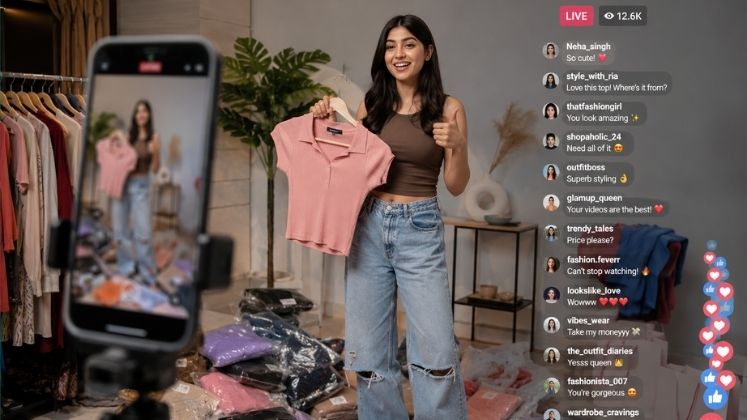
Kofluence also identified live commerce as the next major growth opportunity within the sector. Although India’s live commerce ecosystem remains considerably smaller than China’s, the report stated that momentum is accelerating rapidly. It estimated that India could witness between 2.27 million and 3.43 million live commerce campaigns across platforms during 2025–26, generating gross merchandise value (GMV) of Rs. 6,600–13,200 crore (US $685 million – US $1.37 billion) through livestream-driven sales.
Instagram currently dominates live-stream viewership, with some sessions attracting up to 1.2 lakh viewers. Meanwhile, commerce-led platforms such as Amazon Live, Flipkart Live and Meesho are increasingly converting creator engagement into direct purchases, signalling a broader shift towards integrated social commerce in India’s digital economy.





 Bharat Tex Special Report 2026