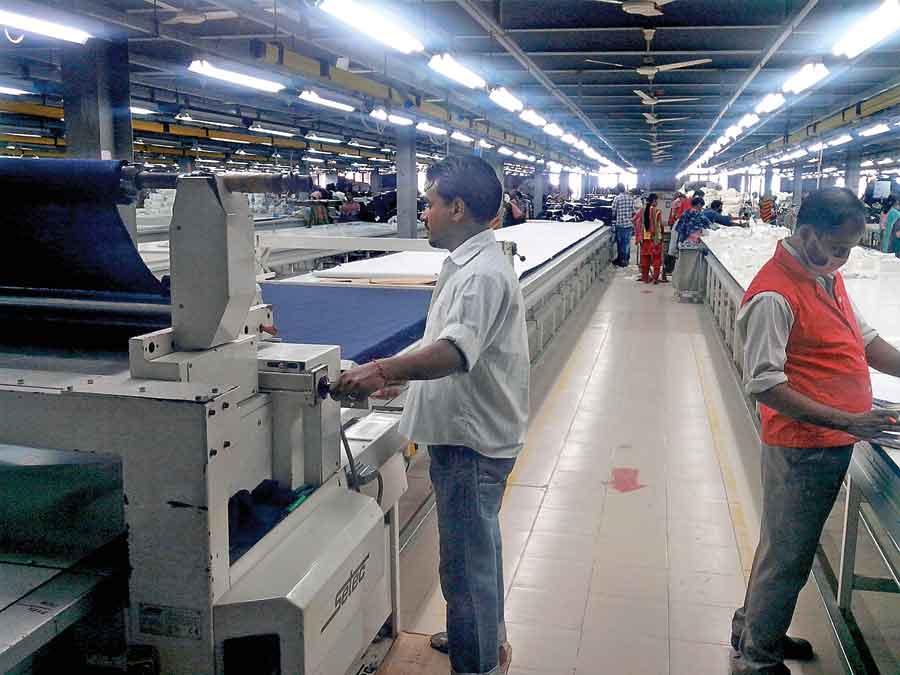
Method Workshop has a dominating presence in the Indian market providing consulting services on Cut Order Planning, PMTS, RFID based production tracking to various industry stalwarts like Radnik Exports, Sahu Exports, Banswara Garments, Naser Tanneries and Gokaldas Exports. The consultancy headed by Roger Thomas with over 40 years of experience in garment manufacturing, took upon itself to extend its reach to Bangladesh through the well-established Bitopi Group, a US $ 100 million company manufacturing casual bottoms for buyers like H&M, GAP, s.Oliver, United Colours of Benetton, Kappahl, C&A, Sisley and Zara, with its biggest factory being Tarasima Apparels with a centralized cutting room having 9 automatic spreaders. The process started with free diagnostic study for 3 days to understand and then suggest the area of improvement in sync with the desires of the management.
The cutting room layout of Tarasima Apparels is excellent, fully equipped with modern equipment, 100% cut part inspection is done and faulty panels are replaced using end bits to replace them.
However, fabric reconciliations were not done properly and the information gathered was not being used in the way intended. Grouping of fabrics as per various shades was also not being done, through which considerable improvements in laying and cutting can be achieved.
[bleft] The diagnostic study presented 3 areas of improvements:
Cutting room had the potential of saving at least 1% to 2% of fabric valued at up to US $ 758,784 per annum and envisages an increase
in the productivity by 20% to 30%.
The sewing department could make a productivity improvement of 15%.
Productivity improvement of around 15% was forecasted in the finishing department, which have the potential for further improvement.
Based on the above observations, it was strongly felt that cutting room was the place to start and ProCut was recommended for the right solution. [/bleft]
The CAD facility was also not being used as extensively as possible; there existed a great potential to save fabric using better Cut Order Planning and by making automatic markers. Changing these techniques saved at least 2% of fabric and improved productivity by 15%. The daily production of 50,000 pairs of trousers consumes 64,000 metres of fabrics per day and a 2% fabric savings represents a saving of 33,280 metres per month, amounting to US $ 758,784 annually at US $ 1.90 per metre.
The installation started in May and continued until the end of June with the immense co-operation of Mishal Ali, Managing Director, Bitopi Group and his team. During the process, new methodologies have been totally accepted by the cutting room staff of Tarasima Apparels who were hugely supportive and helpful.
The implementation started with the creation of “Dummy Style” to train the staff. The “End bits” were used to make smaller lays, instead of just being used for replacement panels, which resulted in immediate fabric savings. Teaching the spreading teams to use the new lay-up sheet took some time, at the same time they were taught to use “splicing” techniques by cutting fabric across its width and overlapping layers in-between the two ends of a lay, which can considerably save the fabric; splicing can sometimes avoid faults found in garment components. After splicing the cut end is pulled back to overlap plies as far back as the next splicing mark and overlapping length to make sure that no parts are lost in the lay. This process is also used when one fabric roll ends in the middle of the marker and end bit length is enough to cover at least one complete garment components. Spreading of next roll starts from the next splice mark which is marked on the edge of cutting table before spreading using the marker to establish these points. The splicing technique was taught initially to the CAD staff who learned how to insert splice marks into the markers as they were being made, this ensured that the correct (not too large) splices were used throughout the laying up process.
After the improvement in the spreading and cutting techniques was completed, a new style was tracked and the fabric reconciliation report was generated, only to find that there was dead stock amounting to 540 yards in the fabric store and an additional 50 yards lying in the cutting room in the form of end-bits and incomplete fabric rolls. The same procedure was run for a few more styles and similar level of dead stock was bought to the notice of the management in each style’s fabric reconciliation report. Top management took immediate action to resolve the anomalies and the purchasing was reduced by the average amount of fabric remaining.
These reports now form the basis of monthly meetings during which the management discusses the profit produced by the cutting room against the costed consumption by the reconciliations Now the profitability of this department is constantly managed and controlled.
The management on the advice of the Methods Team now meet to discuss the consolidated reports on a periodic basis to determine the average dead stock levels in the factory. It is done regularly with the top management and as a result, the fabric purchase has reduced by 2%.
The management and staff of the company are excited to be able to save this type of money which has considerably helped the group to increase its profitability.