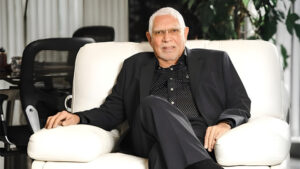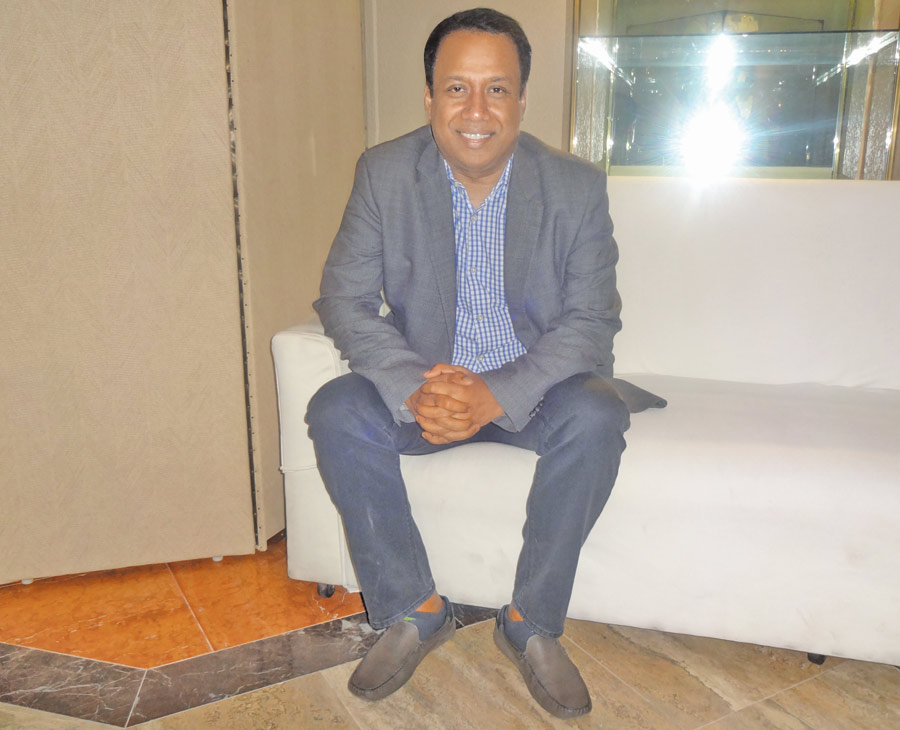
As of today, Bangladesh has the biggest economies of scales for producing knits, compared to any other product category produced in the country, yet manufacturers still complain of lower than average margins in exporting knit apparels because of the plunging FOB prices paid by the buyers. This does not seem to be the case with Crony Group, a US $ 100 million turnover knit composite company with in-house capacities for yarn dyeing, knitting, sewing, and washing, which has the self-belief to discontinue business with buyers if the profitability is not working out. The dynamic and hands-on Managing Director of the company, A H Aslam (Sunny), in an exclusive interaction with Apparel Online shares what gives the company the confidence to work on their own terms.
Catering to buyers such as Mango, Metro, H&M, Adler, Celio, Okaidi, Tom Tailor, Promod, Jennifer to name a few, Crony Group treats each buyer equally and does not accept orders worth more than US $ 18 million or less than US $ 8 million from any one of them. Even though most companies allot 90% capacity to one buyer, Crony believes in giving only a maximum of 20% of its capacity to a single buyer to cushion business in case of any fluctuation and as of now H&M has been given two sewing floors – Metro Group one sewing floor and Okaidi one sewing floor; efforts are made to allocate the same floor to a buyer every time. Taking a cautious approach, Crony Group checks its turnover with the buyers and out of all the buyers, whichever is not doing well, is asked to increase the FOB or capacity; else a new buyer is added in its place.
Although profit is the primary objective behind working with a company, Crony Group also stops working with buyers/brands due to reasons such as the absence of long-term planning, production forecasts and slow approval processes. “Value addition in terms of embroidery, printing and washing is also critical for the sustenance of business with a brand. In 2014, we pegged the lowest FOB at US $ 2.6 and it was the responsibility of the merchandiser to find a buyer or brand which can give FOB greater than this. Similarly for 2015, our lowest FOB will be US $ 2.7 and every cent’s increase in the FOB is supplemented with in-house capabilities for washing, embroidery and printing,” elaborates Aslam. Crony Group has a washing capacity of 20,000 pieces per day, 8 embroidery machines from Tajima and carousel printing machine from M&R.
The next focus area of Crony Group is on effective management and efficiency improvement within the organization. But before improvement comes monitoring, for which Key Performance Indicators (KPIs) have been defined by Aslam, who monitors them closely on a weekly basis. “We monitor the manufacturing and merchandising separately. Manufacturing is monitored on a weekly basis and I visit our unit every Saturday, to attend a two-hour meeting with 85 personnel from the IE, production, quality and financial departments. A presentation is given to me by every department on KPIs such as cut-to-ship ratio, helper ratio; target vs achieved productivity and quality rejection rate. Due to the presence of all departments, the information presented to me is precise and accurate,” explains Aslam. The merchandising department is monitored on a daily basis by Aslam, and a two-hour meeting is held with the merchandising team to keep taps on the progress in production orders, approval status, raw material sourcing status, demands of buyers and conformance to the pre-defined Time and Action Calendar.
“I’m proud to say that we have hired no expats in our company. It’s all about training your people, and we have focused on honing the problem-solving skills of managers due to which the subordinates do not run to their seniors for tackling work-related issues.” – A H Aslam, Managing Director, Crony Group
Unlike most of the apparel manufacturers, Aslam does not complain about the acumen, capabilities and performance of the country’s middle management. “I’m proud to say that we have hired no expats in our company. It’s all about training your people and we have focused on honing the problem-solving skills of managers due to which the subordinates do not run to their seniors for tackling work-related issues so I can focus on more productive things,” avers Aslam. Even for the aspects of efficiency and productivity improvement, Crony Group does not rely on expats though the company did hire a team of 6 Sri Lankans for training its people, who are now looking after the same in the company. “We have also focused on the communication skills of our managers due to which in 2014 we did zero air shipment or discounts, even in times of political turmoil and hartals,” he says proudly.
Abanti Colour Tex Ltd. (a unit of Crony Group) received 3 awards of Social and Environmental Excellence (SEE): Platinum Award for Grievance Handling; Gold Award for Innovative Initiative; and Gold Award for Inclusive Skill Development from GIZ and the Bangladesh Government.
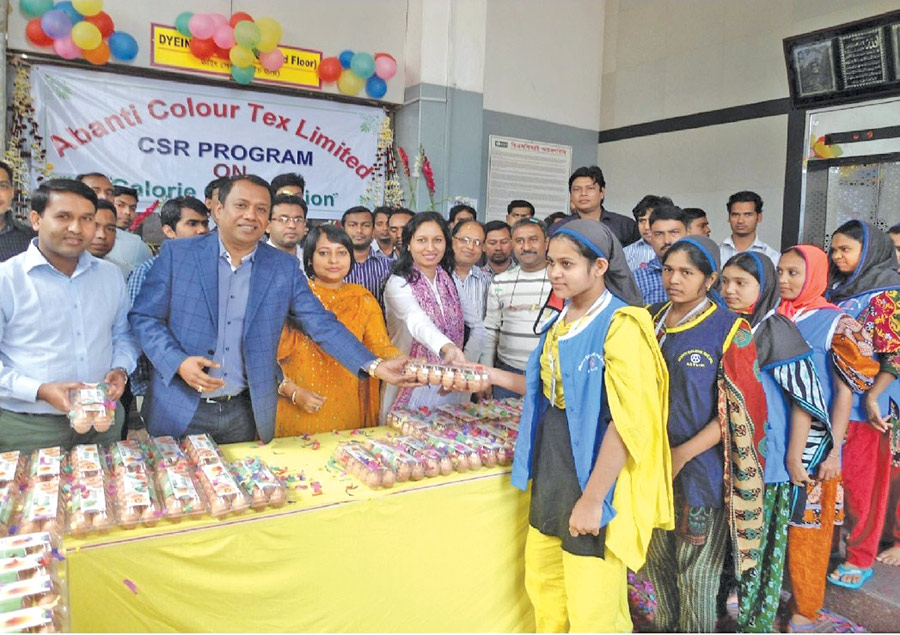
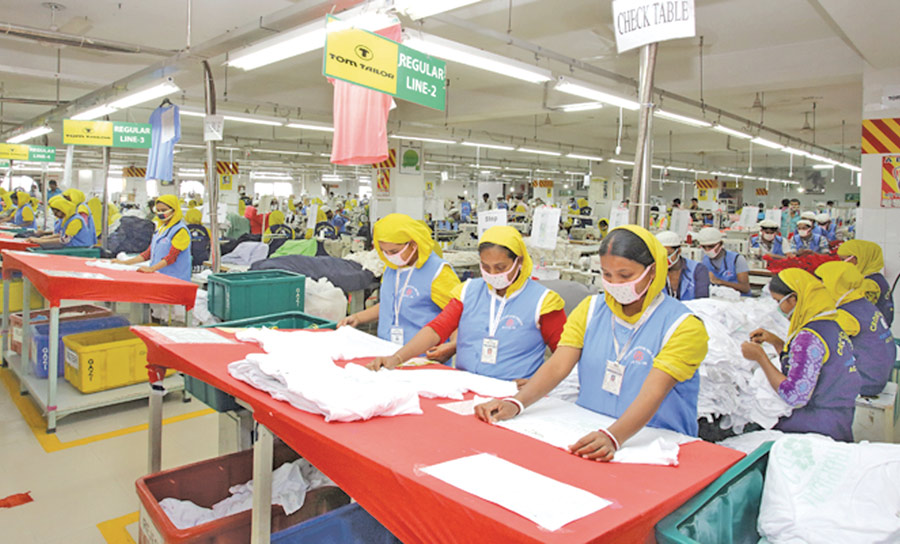
Similar feats have been achieved at the sewing floors with just 20 helpers per 100 sewing machines and the average operator efficiency of 65%, way higher than the national average of 45%. “Five years ago, we used to give 10% salary as incentive to operators for exceeding 50% efficiency mark but now we have revised the same to 75% efficiency, after the 70% wage hike. And out of our 75 sewing lines, around 20 are already working at 75% efficiency,” shares Aslam. Another recent achievement has been the development of two zero defect sewing lines as in 2014 Crony Group recorded an astounding rejection rate of just 0.2%. At the foundation of all such achievements, lies the company’s low migration rate of 3%, a resultant of its focus on employee engagement and welfare activities. “As a part of company’s Calorie Distribution Program, we give 15 eggs, 10 packets of chocolate milk and 2 kg of Milk Vita supplement, to each operator every month. Last year we spent a total of BDT 25,000,000 (US $ 321,000) to the Calorie Distribution Program in our company,” boasts Aslam. Crony Group also helps operators financially for their children’s higher secondary education and even supports the people who want to complete their schooling. “At the middle management level, company-sponsored holiday packages are given based on their performance,” he adds.
With 2,000 sewing machines and 120 knitting machines, Crony Group has plans to establish a LEED certified Green factory, and the company is targeting platinum certification for the same. Named as Crony Apparels, the new unit will have 800 sewing machines. “Presently we are undertaking expansions in our knitting and fabric processing units adding 20 tonnes of fabric knitting and processing capacity, which will satisfy the demand of our sewing expansions to be completed by 2016,” concludes Aslam. Investment in 100 automatic knitting machines from Stoll is a two-year old investment for the Crony Group, which is positive to touch the mark of US $ 120 million in 2015.