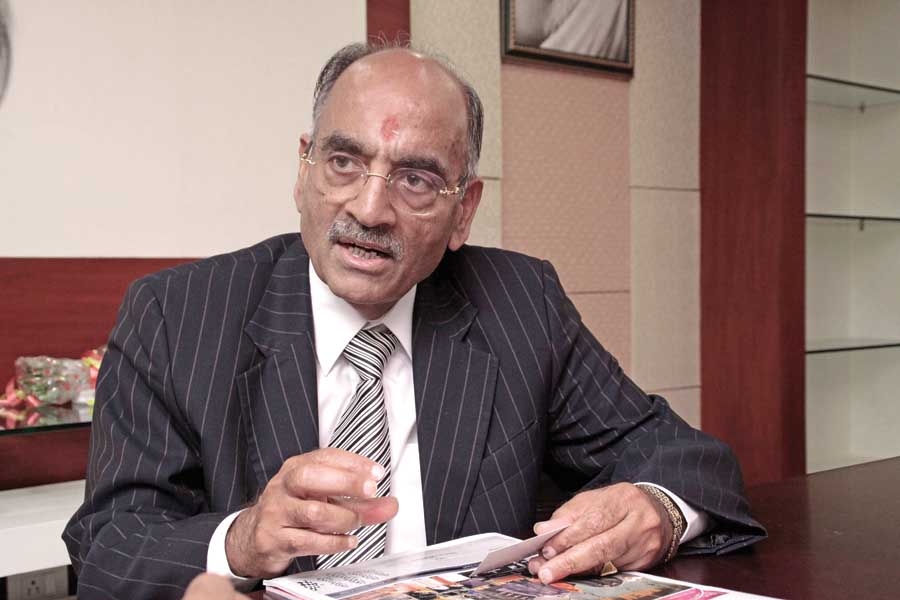
With a turnover close to US$ 1 billion and 24 manufacturing facilities in five states across India, Vardhman Group the manufacturers of yarns, grey and processed fabrics, sewing threads and garments recently inaugurated their new sprawling office premises in Gurgaon. The Group Chairman, S.P. Oswal was present at the occasion. After a small ceremony, the Chairman in his one o’ one interaction with Apparel Online shared his views on various industry concerns along with his expansion plans…
Integrated Textile Policy… “Government has to see farmer’s interest too”
Should we have an integrated textile policy, is a very pertinent question… The recent banning of cotton export than rollback on the same, only demonstrates that such a policy should be made. Though the Government has lifted the cotton export ban to meet prior commitments, it has said that new registrations would not be done until and unless they are convinced that more cotton can be allowed to be exported, but it will remain under OGL. The move ensures that already approved registration would be restored because companies have entered into contract and incurred certain liabilities, now they need to honour their contracts. Some damage will be done but not to that extent if they would not have stopped fresh registration, in that case cotton left for the domestic consumption would have been far below than our expected consumption levels.
As of today we all are critical on the Government’s move but if tomorrow the mills close down then again we will blame the Government for not acting on time. We need to have a balanced view; invariably vested interests sometimes sway the public opinion and Government’s opinion too. The Government also has to see the interest of the farmers; they have fixed the MSP and kept CCR ready in which if the prices fall below the assigned prices they can arrest the fall in prices below which would be detrimental for the farmers.

Private Textile Parks… “Not Being Utilized to Optimum Levels”
A few private textile parks which have been sanctioned have simply emerged as a private place to establish satellite units for holding company; they are not really public parks. Public parks are those where one has many facilities and different entrepreneurs come and join that park. Suppose if I take a park, create my satellite units – one spinning unit, knitting, and put my garmenting… can I say it’s a public park? This is a park which I have created for myself.
Frankly such parks would be more beneficial for the garment sector, but the garment sector in India is not growing at that pace as it should and that is because we have too many disadvantages, which makes us uncompetitive. Unless the Government allows certain labour liberalizations in those parks, entrepreneurs would not be keen to go there; the day they do it, we’ll have more than 100 successful running parks in India.
Labour Laws… “Government needs to take a Stand”Labour liberalization law is a major issue. The Government has to consider which countries we are competing with and what labour laws exist there… the fact is that with our existing labour laws, we cannot compete with them. If we do not liberalize our labour laws, my assessment is that we’ll lose this momentum and the garment export industry might even start shrinking after five years.
[bleft]“I appeal to the Government to have liberalized labour laws for the garment sector. Government should just monitor that there is no exploitation” – S.P. Oswal, Chairman, Vardhman Group[/bleft]
Let’s take Bangladesh’s example; there one can pick a worker today and if tomorrow there is dearth of orders he can simply lay off the worker. If one has business, why would anyone lay off the labour unnecessarily… Similarly, if I have no business then why should I be expected to retain the workers? This kind of liability in the garmenting industry is very difficult to take. So people are extra cautious; they have no alternative but to take other means, then again you cannot get the productivity and enhance the skills of the labour. In my view, the Government in this regards has lagged behind. They should be bolder in this regard; I appeal to the Government to have liberalized labour laws for the garment sector. Government should just monitor that there is no exploitation and if there are too many complaints then required action can be taken against the company.
Women workers need to be encouraged and 85 per cent of employment in this sector can go to females for stability. In China they have this model and it is working very well for them.

NREGA… “Deterrent to Industry”
Schemes like NREGA are not productive schemes in my view. If people become dependent on the Government for everything, then why should they work? It doesn’t fit in the work culture of the country. What we can do is to assure employment to people, even those who are not easily employable. It’s a paradoxical situation; industry suffers because of lack of workers and the Government is spending Rs. 40,000 crore on scheme like NREGA. Movement/migration from one place to the other should be encouraged as it creates dynamism and ability to adapt. If Punjabi’s would not have gone out to countries like Liverpool or other places, I don’t think they would have been as progressive as they are today.
We as a company are trying to enhance our productivity and reduce the labour content. We are investing more money in order to improve productivity and save labour.
Expansion Plans… “Ongoing Process”
We are already in the process of implementing expansion schemes worth Rs. 1600 crore in the next two years and we are quite occupied by those. We are now enhancing our capacity in spinning as a group to one million, now we are just short of 50,000 spindles. We will be first group in the country to touch this milestone. We are expanding our fabric business too, so our hands are tight for another two years and certainly after that when we meet, I will have some schemes share as expansions are an ongoing process.





 Bharat Tex Special Report 2026