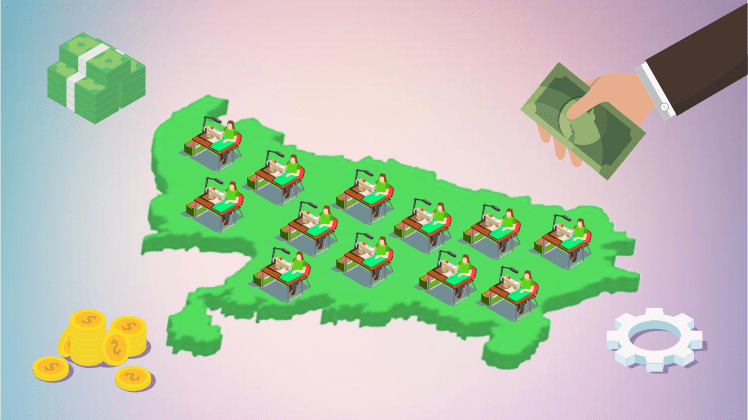
Overall Government support, good infrastructure like land at reasonable prices and basic facilities, availability of raw material and workforce (workers as well as mid-level management professionals) and proper working environment are some of the basic parameters for the growth of apparel manufacturing hub. It is very subjective and every individual must have a different opinion as to which particular state has all these facilities and up to what extent… that too in this new phase of pandemic when challenges are more serious than ever before! But one must agree that Uttar Pradesh (UP) has shown tremendous aggressiveness during the months of lockdown, and if things move as per the planning of the State Government, UP will make good progress in the near future. At the same time, garment manufacturers in the state are also geared up to take advantage of the scenario and to deliver their best.
The most important thing here is the clear understanding and a strong vision for the state, as the Chief Minister Yogi Adityanath recently said that there are many reasons that in the garment manufacturing sector, UP could achieve the same status like Bangladesh and Vietnam.
It is pertinent to mention here that Apparel Resources had highlighted the same point almost 5 years back and even wrote a letter to Akhilesh Yadav, the then Chief Minister of the state.
Looking at the challenges of employment creation, the state has also started reworking on its Handloom, Powerloom, Silk Textile and Garmenting Policy 2017. Awanish Kumar Awasthi, Additional Chief Secretary, UP, says that the state will work to prepare a roadmap for developing Uttar Pradesh as a leading textile hub.
As of now when most of the apparel manufacturing hubs are struggling to get the skilled workforce, UP has the edge in this regard. The Government has started working in the right direction. Overall, 30 lakh migrants have returned to UP in the past two and half months. To provide jobs to the workers who were earlier working in other states and recently came back to their home state (Uttar Pradesh), the State Government has done skill mapping of these workers. With a population of 24 crore, the state has enough manpower, and also, the majority of workforce is skilled as far as apparel manufacturing is concerned.
Navneet Sehgal, Principal Secretary, Department of Khadi and Village Industries and MSME and Export Promotion Bureau of the Government of Uttar Pradesh, has shown good progress with regard to managing workforce.
The perfect example of Government aggressiveness was seen recently when Noida Apparel Export Cluster (NAEC) asked for 2 lakh workers and the state offered the list of 65,000 workers (specific to garment industry) within a few days.
The State Government hasn’t shown this aggressiveness on the garment manufacturing front displayed during the lockdown period for the first time. Two years ago, Yogi Adityanath launched the ‘One District, One Product’ scheme with the objective of reviving all leading hubs of the state focusing on their core strengths.
Noida, the biggest apparel manufacturing hub of the state as well as of North India, is recognised as the city of garment. With 3,000 garment factories and 10 lakh workers, this city is doing 10,000 crore apparel export per year.
Along with that, the state also has naturally developed clusters like Mau for powerloom, Farrukhabad for textile printing, Lucknow for chikankari and zari zardozi, Hapur for home furnishing, Hardoi for handloom, Etawah for various textile products and Kushinagar for banana fibre products. Bareilly, Chandauli, Shahjahanpur and Kasganj are also well-known for zari zardozi work. Leading global brands are getting home-based handwork from these clusters.
All these clusters are getting support under the ‘one district, one product’ scheme.
On the other hand, Varanasi is also known for its specialised kinds of fabric and textile products. Meerut, Agra and Kanpur, which are known for leather and sports products, are also witnessing a good number of leading companies into apparel manufacturing.
Uttar Pradesh has two textile and three apparel parks. Ghaziabad-based Apparel Park still has more than 30,000 sq. metre land available. Kanpur’s Apparel Park is also operational in a good way and has proved to be the lifeline for city’s knitting companies, especially for dyeing operations.
The Textile Park in Farrukhabad, spread over an area of 14 hectares, is in progress and is expected to be built at a cost of Rs. 200 crore. Similarly, Eco-Tex Textile Park (34 acres), Bareilly, is also sanctioned, but both the projects need to be pushed, as these were sanctioned 4 years ago but there’s been no major progress yet. Along with all this, the four-year-old efforts of the industry and Government have also started showing results now. Progress regarding the Mega Apparel Park in Sector 29 near Yamuna Expressway is now speeding up; in last few days, about 20 plots have been allocated to various apparel export houses of Noida.
Overall, this park will have more than 100 units. So far, five leading export houses of Noida – Sahu Exports, Priti Wears, BK Fashions, Maharana of India and Orient Fashion Exports – have been allotted lands here. The apparel park scheme was extended to 30 June. Around 73 companies applied for land in this park recently. Arunvir Singh, CEO, Yamuna Expressway Industrial Development Authority, has been very actively supporting the industry in this project.
As per industry estimates, in the long run, around 5 lakh workers will be required in this park, which is spread over 300 acres. The production will start in the next one and a half years.
Industry shares that this project will help the factories to have their major operations carried out under one roof and work more efficiently and comfortably. Most of the companies, who have applied for land here, also have plans to expand in the long run.
This ambitious project, which is supported by Noida Apparel Export Cluster (NAEC), will bring a significant and positive change in the industry as far as Noida is concerned. NAEC also has more long-term plans for the overall growth of the industry. The Government has plans that villages or areas that are close to state highways and have some basic facilities will be developed as dyeing hubs in future. This way, the villagers in these areas can work closer to their homes.
In a latest decision by the State Government, Agra and Aligarh will also be developed as garment hubs.
There are many schemes of State Government, be it skill development and training or scholarship of Rs. 500 per month per student of vocational subjects of textiles. It also offers a grant of Rs. 5 lakhs per college for the purchase of new handlooms, accessories and raw materials. The industry has some interesting facilities and one of them is incentives for the construction of staff quarters, hostels, dormitories – including reimbursement of 60 per cent interest for 7 years (except Gautam Budh Nagar); maximum Rs. 5 crore per year and Rs. 30 crore in total.
The State Government has shown enthusiasm to change labour laws and has taken the decision in favour of the industry. The companies are exempting from almost all labour laws in the state for a period of 3 years.
Uttar Pradesh has an ambitious target to become US $ 1 trillion economy by 2024. It is going to have its Assembly Elections in less than 2 years (February-March 2022) and the existing State Government will leave no stone unturned to win this election. To ensure lakhs of jobs in the state, the industry seems to be working in the right direction, and the coming 2 years are going to be very crucial for Uttar Pradesh. All the industry stakeholders are required to be on their toes for the same, as there might never be such favourable conditions. None of the other states in India or even the leading apparel manufacturing countries Bangladesh and Vietnam have such kind of versatile strength.




 Bharat Tex Special Report 2026