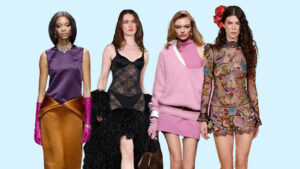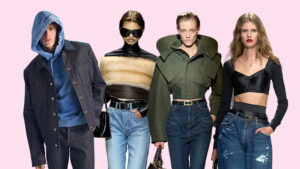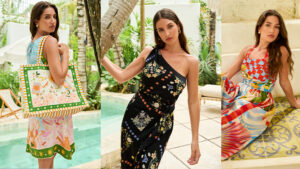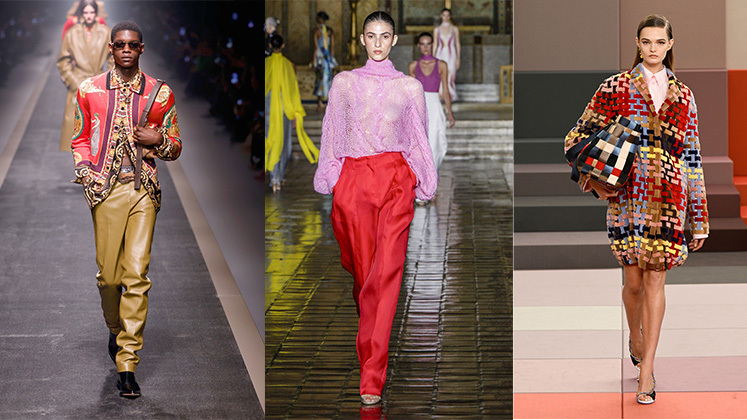
On the Spring Summer 2026 runways, colour returned not as an accent, but as the central narrative – assertive, highly saturated, and deliberately unapologetic. What has come to be widely termed dopamine dressing signals a decisive shift away from the subdued palettes that have dominated recent seasons, replacing restraint with a sense of visual immediacy and emotional uplift. Designers and high fashion brands across fashion capitals were seen embracing colour blocking as both a styling device and a statement, constructing looks that felt less coordinated and more instinctively assembled.
At houses such as Versace and Fendi, saturated hues were layered in graphic compositions spanning bubblegum pink colliding with lime green, electric blues offset by acid yellows, while Prabal Gurung explored a more fluid interplay of hot pinks and reds, allowing colour to move across the body rather than sit in rigid partitions. The resulting effect was less about precision and more about energy, with garments appearing almost kinetic in their vibrancy.
This resurgence of bold colour reflects a broader recalibration within fashion, where maximalism is once again gaining ground. In contrast to the quiet luxury narrative, which favoursunderstatement over neutrality, dopamine dressing leans into visibility and emotional resonance. Colour here becomes a tool of self-expression that is direct, immediate, and universally legible. It is less about seasonal trend cycles and more about a psychological response to dressing, where garments are chosen not just for aesthetic alignment but for the way they make the wearer feel.
From a commercial perspective, this direction offers significant adaptability. While runway interpretations may lean toward extreme contrasts, the underlying principle — unexpected colour pairing — translates easily into retail. Designers and brands can approach this through modular styling, looking at pairing a single statement hue with an otherwise neutral base, or introducing contrast through accessories and layering. The emphasis is not on matching, but on juxtaposition, allowing colour to disrupt instead of harmonising.
As the season progresses, expect this palette to expand further into prints, textures, and even occasionwear, with colour blocking moving beyond casual dressing into more elevated categories. Ultimately, dopamine dressing marks a return to fashion as an emotive medium — one that prioritises joy, individuality, and a certain visual audacity.