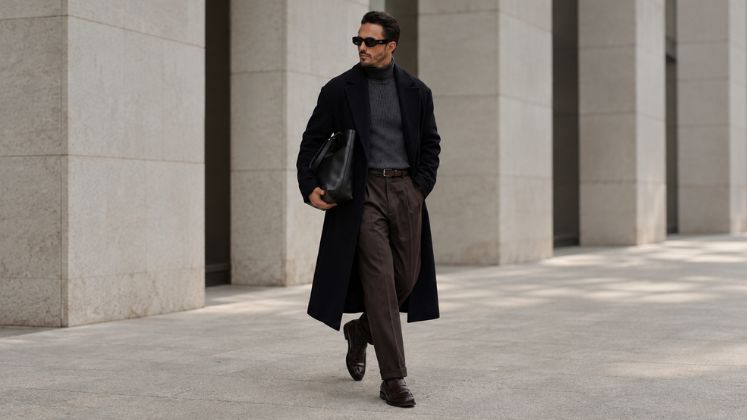
There are coats that complete an outfit, and there are coats that are the outfit. A long raglan overcoat falls firmly into the latter camp. Unlike a traditionally tailored coat with a structured shoulder, a raglan sleeve extends in one piece to the collar, creating a softer, more rounded silhouette, go roomy and knee-length and the effect feels dramatic without tipping into costume.
The construction has real pedigree. It is a loose, unstructured coat named after a Scottish estate near Inverness, traditionally cut from heavy tweed with a fly-front closure and turned-up collar to keep out wind and rain. Because the sleeve eliminates the shoulder seam, the coat sheds water more effectively than a set-in-sleeve design, which is part of why the silhouette has endured for over a century largely unchanged.
Contemporary menswear has leaned into it as an oversized, off-duty staple. Drake’s has built its own reputation partly on the balmacaan, cutting its version narrower and shorter than the vintage original for a more current fit. Massimo Dutti currently carries a short wool-blend raglan sleeve coat as part of its A/W range, while Studio Nicholson and Harris Wharf London both work the silhouette into elevated basics; the latter’s oversized balmacaan finished in raw-edge cuffs and unlined virgin wool melton is a good reference point for the “roomy but not costume-y” balance the shape depends on. At entry-level price points, Madewell and Uniqlo have long kept versions of the balmacaan in rotation, proof the silhouette scales from designer to high street without losing its identity.
This kind of coat also makes sense against the wider proportions now standard in menswear, relaxed jeans, wide chinos and chunky trainers can look bottom-heavy under a short, slim coat, but a generous raglan balances the frame out. Grey and camel remain the safest bets, but dark brown, herringbone and subtle checks add more interest, and the coat reads best over jeans and chunky knitwear rather than tailoring.
The raglan-specific silhouette is still a niche ask in Indian retail, India’s formal outerwear category is dominated by structured, set-shoulder overcoats from brands like Van Heusen, Raymond and Louis Philippe, positioned squarely for office and wedding-season wear rather than the loose, off-duty balmacaan cut. Where the raglan shape does show up locally is through global retailers with an India footprint: Marks & Spencer India stocks wool overcoats as a category, and Zara’s India stores carry the same international outerwear range, as its global stores, making these the most accessible entry points for Indian shoppers wanting the actual raglan cut rather than a structured approximation of it. Given how well the shape suits layering over kurtas and looser Indian silhouettes in the north’s short but sharp winter window, there’s a genuine opening here for homegrown D2C outerwear labels to build a version of their own rather than leave the category to import