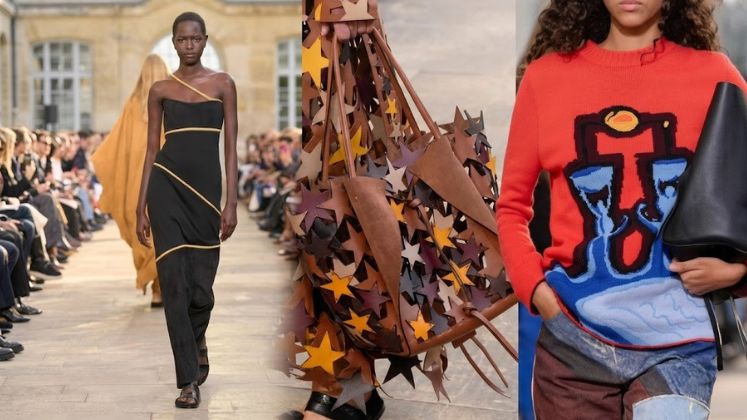
From literal tarot prints to zodiac jewellery, fashion is turning symbolic systems into expressions of identity, self-expression and personal meaning. Indian brands are interpreting the movement through both Western esotericism and local spiritual traditions.
Internationally, designers have used tarot imagery not only as a graphic motif but also as a framework for developing collections around symbolism, identity and transformation. Dior has repeatedly drawn on tarot, from Maria Grazia Chiuri’s Resort 2018 collaboration with Motherpeace tarot creator Vicki Noble to her Spring 2021 couture collection, Le Château du Tarot, which translated the major arcana into medieval silhouettes, embroidery and cinematic storytelling. Gucci similarly used tarot-inspired major arcana imagery in its Spring 2017 collection, while Burberry’s Spring 2026 collection incorporated imagery from the Rider-Waite-Smith deck into scarves and trench coats.
More recently, Gabriela Hearst extended the approach for Spring 2026 by building the collection around all 22 major arcana cards and treating them as stages in a broader journey through life. In this interpretation, tarot moves beyond predicting the future to become a framework for examining the present and exploring ideas of transformation and personal identity.
For fashion, the development is less about reproducing tarot cards literally and more about translating symbolic systems into product and brand narratives. Tarot offers an established visual vocabulary through its elaborate borders, figures, celestial references and archetypal characters, making it adaptable to prints, embroideries, graphics and accessories. At the same time, the meanings associated with individual cards give brands an additional layer of storytelling, allowing garments to represent particular attitudes, ideas or stages of life.
The broader interest in mystical references is also visible beyond apparel. Zodiac signs, birthstones, celestial motifs and talismanic forms have increasingly been incorporated into jewellery and accessories, where symbolism can be connected more directly to the wearer. This expands the opportunity from a purely visual trend into one centred on personal meaning and identity.
India presents a distinct interpretation of this movement, given the country’s existing relationship with astrology, mythology and spiritual symbolism. Several Indian labels are already using the visual language of tarot directly, while others are approaching the wider trend through celestial imagery, astrology, talismans and personalised spiritual products.
Gujarat-based Rafu’d currently carries a dedicated Tarot collection centred on a Tarot Jacket, while its broader design language draws on Indian narrative art and traditional storytelling. Loom of Thirds, the Kolkata-based art-led streetwear label, has developed a Tarot Collection around playful interpretations of the major arcana, including designs such as The Sun of Frogs, The Sun of Cats, The Star of Cats and The Moon of Frogs. The approach uses illustrated and surreal characters to reinterpret the traditionally mystical imagery through a contemporary streetwear lens.
Nebulyn, a premium Indian direct-to-consumer lifestyle and apparel brand founded in 2025, takes a more straightforward graphic approach, translating The Sun, The Fool and The Moon into oversized and regular-fit unisex T-shirts. The brand positions the collection around symbolism and self-discovery. ORE OFE similarly uses tarot imagery on an oversized 240 GSM cotton T-shirt, pairing card-inspired graphics with messaging around self-discovery and navigating the unknown.
These labels represent the more accessible end of the movement, where tarot functions primarily as a graphic identity. The imagery can be applied to everyday products and incorporated into streetwear without requiring consumers to engage with the cards’ traditional meanings.
NOIB offers another interpretation, taking tarot into contemporary womenswear through products such as the Celia Shirt – Tarot, a structured Giza poplin shirt featuring placement print detailing, alongside tarot versions of midi and maxi dresses. Its Resort ’26 range also includes tarot interpretations across swimwear and resort pieces, including the Hazel Bikini Set, Connie Bikini Set and Nua Pareo.
This approach indicates how tarot can operate as one design element within a broader commercial collection rather than becoming the sole identity of a product. Placement prints, borders, smaller card references, celestial motifs and abstracted figures allow designers to incorporate the visual language without making the garment resemble a literal tarot card.
India also has an earlier precedent for translating tarot into fashion. Satya Paul presented a Bridal Tarot collection at Lakmé Fashion Week in 2010, using symbols including the Empress, Lovers, Wands and Chariots across saris and bridal apparel. The collection interpreted tarot through an Indian occasionwear vocabulary, combining the imagery with colour, embellishment and traditional silhouettes.
The current market differs in the breadth of categories through which mystical references are being interpreted. Tarot can now sit alongside astrology, celestial imagery, spirituality, personalisation and wellness, creating a wider symbolic-fashion category rather than a single tarot-specific aesthetic.
Within this emerging space, the market can broadly be viewed through four expressions. The first is graphic mysticism, encompassing tarot cards, moons, stars, celestial illustrations and occult-inspired artwork across T-shirts, shirts and streetwear. The second is decorative symbolism, where tarot and astrological motifs are translated into prints, embroidery, jewellery and accessories. The third is talismanic fashion, which uses zodiac signs, gemstones, birthstones, yantras and spiritual symbols as objects of personal meaning. The fourth is personalised spirituality, where garments and products are developed around an individual’s birth chart, planetary associations, colours or spiritual identity.
The progression from graphic imagery to personalisation also gives the trend relevance beyond seasonal aesthetics. While individual motifs can change with fashion cycles, symbolic products can be connected to a consumer’s identity or personal belief system, providing brands with another route to product storytelling and differentiation.
For fashion businesses, this creates multiple avenues for interpretation. Print-led brands can adapt tarot through their own illustration languages, while womenswear labels can use card imagery as an art-direction tool rather than an overarching theme. Jewellery brands can build around zodiac signs, birth charts and celestial systems, while luxury and bespoke labels can connect astrology with colour, gemstones, craft and customisation.
In the Indian market, the development is therefore not limited to a direct tarot revival. Instead, tarot forms part of a broader movement towards symbolic and spiritually informed fashion, in which established systems of belief are being translated into contemporary products, graphics and personalised experiences.