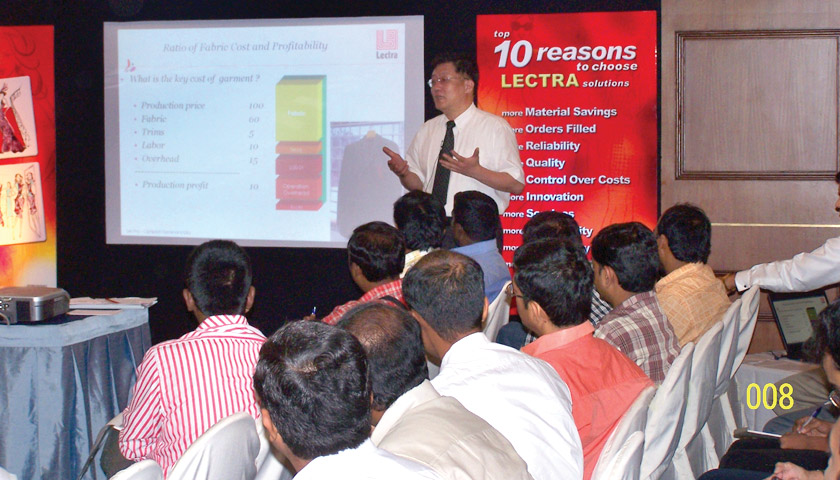
The focus of the apparel industry at present is to reduce its manufacturing cost and increase profitability. Machinery upgradation, operator training and overall management supplemented by a motivated operator play a vital role. However, fabric is the single major factor that controls the cost of a garment. Controlling the cost in cutting department depends on savings in fabric, reducing marker making, spreading, cutting and bundling time. Minimising one factor may increase another; balancing all parameters is important. This activity is also known around the industry circle as ‘lay plan’, ‘cut-order plan’, ‘lay-lot plan’, etc. Cut-order plan is basically optimising cost that relates to working out the right combination of the lay length, lay height, marker way, and roll selection for a given order quantity, keeping in mind constraints such as table length, cutting heights, fabric defects, shade lots, delivery priorities, etc.
Generally the ‘size mix’ and marker combinations are generated based on factors like size and colour ratio. Spreading and cutting processes have infrastructure constraints such as lay height (maximum number of ply that can be cut using available straight knife cutting machine), and lay length (working length of table available), and working out the most optimum cutting plan under all these factors and constraints is a big challenge. Along with optimising lay plan, the operator also has to calculate fabric utilisation based on fabric roll length available. To maximise fabric utilisation, roll length needs to match the multiple of lay length. The roll allocation to lay is best done using mathematical algorithm, subject to fabric being defect free.
The ultimate goal for a business organisation is neither minimising number of lays nor maximising use of fabrics rather to optimise the ‘total process cost’. A complex situation, it can only be solved by scientific operational research tools. A lay planning software, such as Optiplan from Lectra, uses mathematical algorithm to rationally and scientifically decide the most cost-effective way to spread and cut the order subject to list of constraints and priorities given by the company.
Lectra, a leader in integrated technology solutions and dedicated to the soft goods industries, recently organised a seminar in Bangalore on ‘How apparel industry can achieve operational improvement in productivity and profitability’. The key presentation at the seminar was done by Harvey Tseng, Principal Consultant, Lectra Asia, on the new version of Optiplan, a powerful and comprehensive cut-order planning and optimising software.
Features of Optiplan
Optiplan is a cut-order planning and optimisation solution to simulate costs and to plan for new production cycles. It fully integrates the cutting room’s various technologies into a single unique process, incorporating ERP, plotting, CAD and CAM systems to accelerate planning, costing and cutting processes.
Optiplan can simulate a range of different planning and manufacturing scenarios, immediately showing the impact of each scenario on costs and production time – down to the unit level. Each process, from marker selection through spreading and cutting, is optimised to give the lowest cost and the most efficient cut plan equation automatically within minutes. It selects the most efficient marker combinations and suggests new ones thereby facilitating precise calculation of material consumption for costing and purchase management. The result is substantial fabric savings of up to 5% and productivity improvement.
Optiplan delivers the selected scenarios to spreading and cutting equipments as executable plans, considerably reducing errors downstream and minimizing unnecessary costs and waste. Constant data results in more cost-effective and consistent cutting; and uniformly higher-quality products. Also, orders and related data can be easily exported and rapidly transferred from one Optiplan station to another. This feature is extremely useful for clients working with remote production sites that are also equipped with Optiplan.
When combined with a fabric management system, Optiplan’s algorithm-based automatic planning feature allows the definition of marker lists according to the availability of material from stock. Manufacturers can easily enter, edit and view fabric roll information in order to improve the efficiency of material usage. Through sophisticated new algorithms, this unique software tests a large variety of size, model and marker combinations respecting material and cutting-room parameters, such as fabric widths, table length, production equipment, labour quantity and costs.






 Bharat Tex Special Report 2026