Development in digital printing technology today to a large extent is directed towards enhancing productivity through ‘speed’ as the mantra for survival. The critical question is do we have the right components to support speed?
Team SW takes a closer look at the challenges ahead…
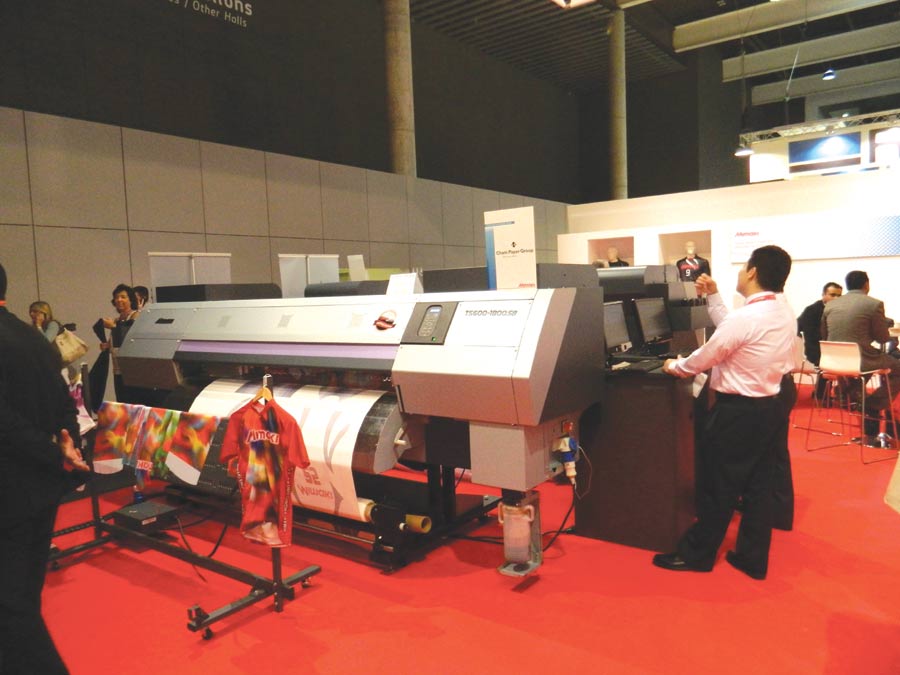 There have been many attempts by leading manufacturers of digital printing machines to induce speed. In fact, a 1000 sq. metres per hour, printer was also on display at ITMA 2011 but at a much lower resolution… Does it justify such investment? Some major technical issues do occur while running a digital printer at that high speed, which includes force and equilateral drop size of the ink. In a machine with 36/90 heads, there is a lot of wind generated with the force of so many heads when moving together and combined with the equilateral drop size and speed, the machine is bound to miss one of the dots and in this case if all the dots do not register, the print will lack its sharpness. Imagine 90 heads lined up together and with thousands of nozzles firing at that speed at the same spot, even a tiny bit of misalignment will produce a blurred image.
Though the concept of speed is good, a lot of work still needs to be done to make it workable before it is brought on to the shop floor. Putting bigger and more heads to increase speed is not the solution. From a practical angle it should have been the head manufacturers making faster heads rather than the machine manufacturers making faster machines. Also for fashion we need sharper heads.
Another important element that should technically support faster machines is ink, most important is consistency and run-ability of an ink. Many inks clog at a speed of 100 metre per hour. It is important for users to first test the ink for at least 5 days before buying the brand as each ink has its own applicability and it is important that it matches to the requirement of the machine to give clean sharp images.
Besides the print head and ink, the RIP (Raster Image Processor) is the most important and also the most error prone software solution in the printing process. The RIP facilitates speed and transmits reliable information for creation and management of priority orders. But does it do this efficiently and seamlessly… Does it match colour easily and accurately, allow creation, view, edit, and with multiple colour ways do these features that synchronize with the machine speed… these are critical posers that need to be addressed.
Clearly, the industry needs machines which will give value for money, delivering cost-effective products with good maintenance.