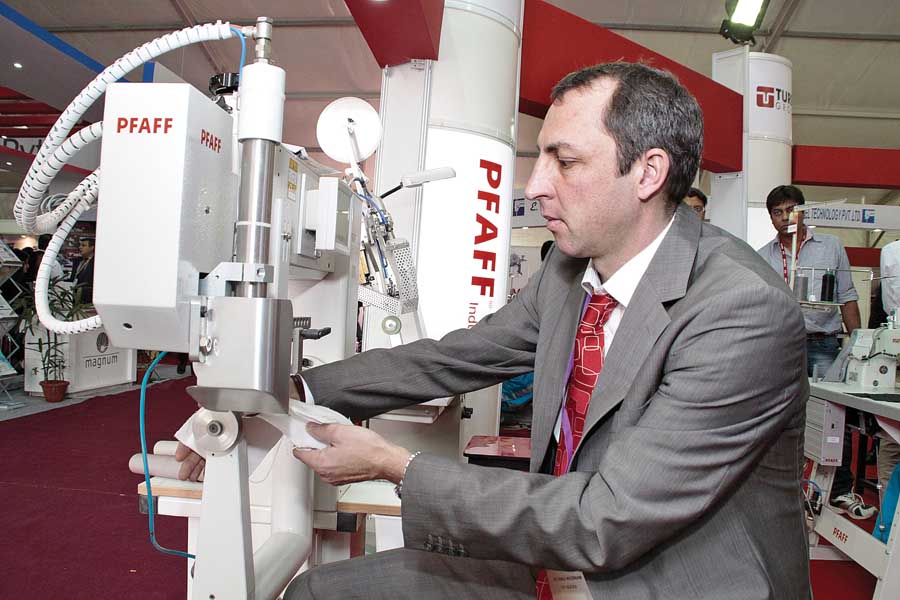
Pfaff with a long history in the field of welding technologies, started working on these technologies in the year 1940, and patented its first hot-wedge welding machine as early as 1942. Spearheading the pioneering effort of Pfaff, Thomas Westermann, a welding specialist, discusses with Team StitchWorld the technology now popularly used not only for sportswear manufacturing, but also for products made from technical textiles including tents, covers, parachutes and many more similar products.
The most essential component for welding is the fabric that would be welded, which should be at least 70% thermoplastics in composition like polyester, polyamide, polyethylene and polycarbonate, in absence of this minimal composition the machine would simply not weld or join the seam. “Welded seams are stronger and much more durable than sewn seams, and also to mention are absolutely leak proof,” starts off Thomas Westermann. “Heat, Pressure and Speed are the three factors which influence the process of welding,” he adds. Heat is required for making the material ready for welding, and hence varies from material to material; pressure, applied through the pressure roller welds the heated materials together, and is also different for different fabrics; and lastly the speed of the machine decides its productivity.
Although there are in total 5 methods of welding seams – hot wedge welding, hot air welding, ultrasonic welding, hot air tape welding and laser welding, in actual application only three technologies of hot wedge welding, hot air welding and ultrasonic welding are used. For the purpose of hot air tape welding, a tape attachment is attached to the hot air welding machine, to impart additional water repellency and strength, and is also used for welding light-reflecting safety tapes to the seams. In case of laser welding machines, a hot wedge is replaced by a laser emitting diode, although serving the same purpose but accounts for increment in the pace of welding.
Ultrasonic Welding Machines
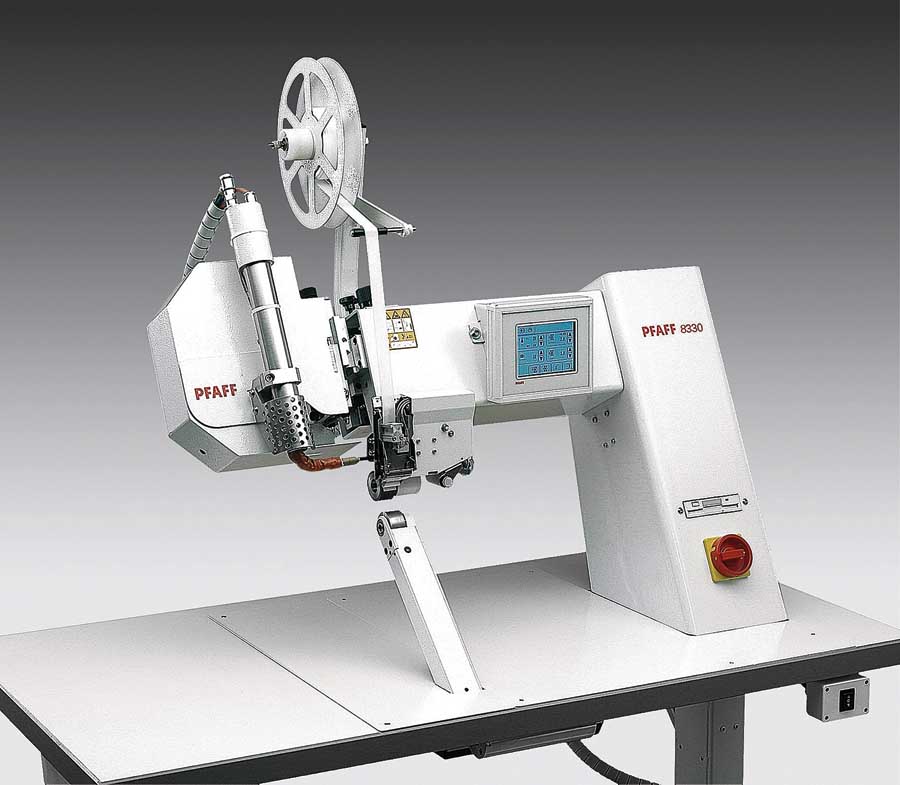
The most successful among the wide array of welding solutions from Pfaff is its series of ultrasonic seam welding machines due to the diversity of operations that can be done by this welding technology. The Pfaff 8301, 8310, 8312, and 8318 ultrasonic machines have been developed by Pfaff for sewing filter bags and pleated filters, medical mattresses, pillows, bullet proof vests, blinds and awnings, isolations, shower curtains, outdoor garments and operation garments, bras, lingerie and other similar products. The technology for ultrasonic seam welding is unique as it is done by an anvil wheel on the top and a sonotrode protruding from the sewing bed. While joining the seams, the sonotrode keeps oscillating horizontally at pre-programmed amplitude, making contact with the fabric.The major welding parameters are speed of the anvil wheel, amplitude of the sonotrode, speed and style of the wheel.
The style of the anvil wheel defines the nature of the seam – the anvil wheel with flat circumference is for basic welding operations as the seams are not flexible, for sewing tents, curtains and other similar products. The anvil wheel with a triangular circumference is for performing the operations of cut & seal simultaneously, for the similar product category like the previous one. The above two wheels generate seams offering limited water resistance, hence are not suitable for sportswear products. Anvil wheel with parallel rows of square-dots on the surface of the circumference giving a stitch-like appearance to the seams make it suitable for garments and technical textiles by improved levels of flexibility to seam and water-resistance.
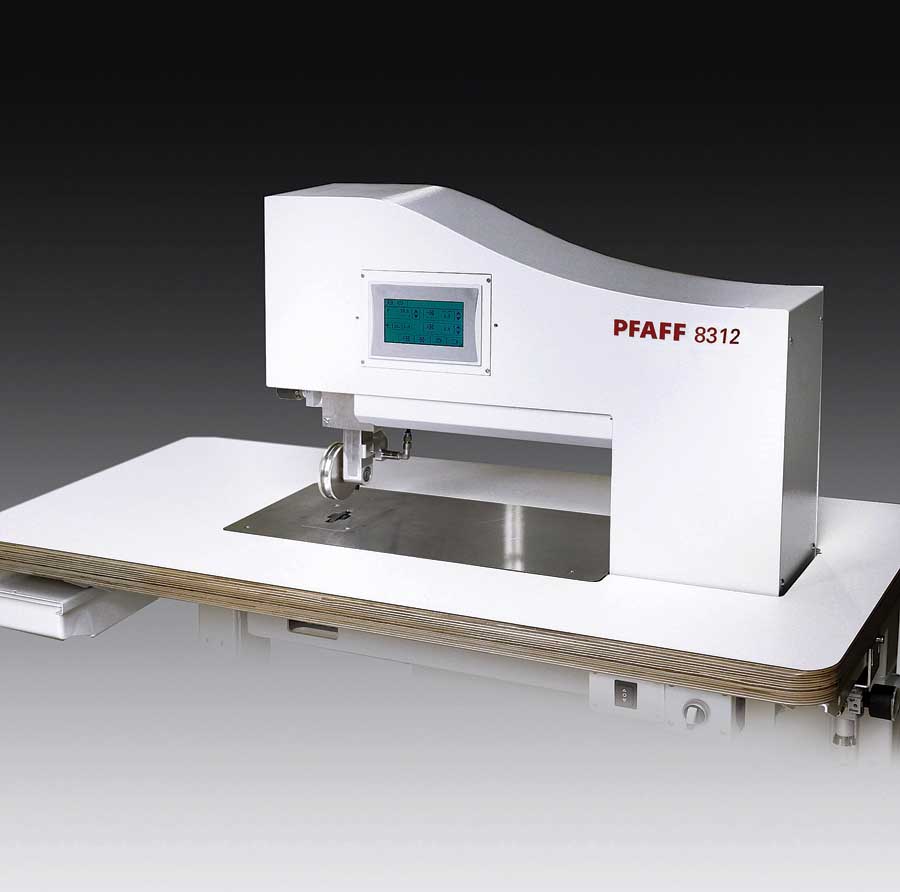
The last two types of anvils wheels with a dotted surface and other one with diagonal lines engraved on the circumference, guarantee high-level of flexibility and water-resistance suitable for functional clothing, active sportswear and other high-utility products. The welding machines have two separate differential drives for the anvil wheel and the sonotrode, a standard for all.The welding machine comes in two sonotrode options of 7 mm steel and 10 mm titanium sonotrode, with a 35 kHz 400 W ultrasonic generator. With the help of the touch screen panel all the welding parameters and processes can be monitored with ease. The maximum speed of 10 metre per minute and seam width of 10 mm can be achieved.
Hot Wedge Welding Machines
In the Pfaff hot wedge welding machines – the 8320, 8362 and 8390, hot metal wedge is put into contact with the thermoplastic material just before the material enters the pressure rollers, which then fuse the heated panels together, at a temperature of around 450°C and positions itself accurately to be in contact with the material. Welding of tarpaulins, swimming pool liners and covers, conveyer belts, tubes, tents, car and boat roofs (convertibles), tanks, banners, inflatable materials and filters, is made possible at optimum quality levels.
The 8362 hot wedge welding machine from Pfaff is known for its fume-free continuous welding process, while producing seams with no seam marks. Several machines can be run by one person because of the optional track guide in every machine. The machine weighs just about 10 kg and consumes less than 0.8 kW of energy. The machine can weld at the maximum speed of 7 metres per minute and handle seam widths ranging from 26 to 40 mm.The 8320 and 8390 wedge welding machines can handle different material widths and thicknesses, at the highest speed of 10 metres per minute. The 8320 and 8390 wedge welding machines handle different widths and thickness at higher speed of 10 metres per minute.
[bleft]Hot wedge welding is more suitable for welding relatively simple products that are made from less technically advanced fabrics having regular and smooth surfaces. Hot air welding, on the other hand, can be used for more advanced designs and fabrics[/bleft]
Hot Air Welding Machines
In the process of welding through hot air, the design of the machine is more or less the same as that of wedge welding machine but instead of the wedge there is an outlet for compressed-heated air. A temperature of up to 700°C can be achieved with hot air welding machines. The machines under this category are the 8303, 8306, 8320 FP and the 8320-020-061. The 8303, 8306 and 8330 are suitable for manufacturing outdoor and protective clothing, footwear, car seats and arm-rests and all kinds of operations which have to be sealed with a tape. Providing completely water-proof and highly durable seams, the 8330 being the most advanced of all, is 20% more productive and 15% reduced tape consumption than its counterparts.