The Indian apparel industry has urged the Government to introduce a series of policy measures, including a higher interest subvention, extension of the Rebate of State and Central Taxes and Levies (RoSCTL) scheme, a dedicated Green Transformation Fund and faster implementation of PM MITRA Parks, to enhance export competitiveness.
The recommendations were submitted by Dr. A. Sakthivel, Chairman of the Apparel Export Promotion Council (AEPC), during the Board of Trade (BoT) meeting chaired by Commerce and Industry Minister Piyush Goyal in New Delhi.
Among the key proposals, AEPC sought an increase in the Interest Subvention Scheme from 2.75% to 5%, with coverage extended to all exporters and the removal of the annual cap.
It also recommended relaxing Average Export Obligation requirements under the Export Promotion Capital Goods (EPCG) Scheme for exporters affected by market disruptions, particularly those dependent on the US market.
The Council further requested the continuation of the RoSCTL scheme for at least three more years, with its benefits extended to exporters operating under the Advance Authorisation, Export Oriented Unit (EOU) and Special Economic Zone (SEZ) schemes.
To support sustainability, AEPC proposed establishing a Green Transformation Fund to provide long-term soft loans for investments in environmental compliance and ESG initiatives.
It also recommended introducing a Special Scheme for the Apparel Sector (SSAS) based on self-ratified input-output norms to simplify duty-free fabric imports, reduce compliance requirements and improve ease of doing business.
Other recommendations included enhanced government support for worker hostels and affordable housing across major apparel manufacturing clusters, expedited implementation of PM MITRA Parks with a dedicated focus on man-made fibre (MMF) production, and making the Registration-cum-Membership Certificate (RCMC) mandatory for availing export promotion schemes.
Dr. Sakthivel noted that expanded market access through Free Trade Agreements (FTAs), coupled with timely policy support, would enable the apparel sector to contribute significantly to India’s export growth.
Representatives of the Tiruppur Exporters’ Association (TEA), including President K. M. Subramanian also participated in the meeting.
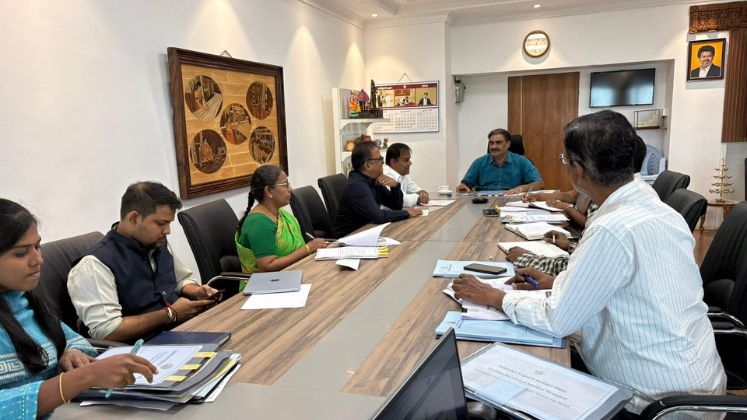
In a separate development, TEA has urged the Tamil Nadu Government to establish a Knitwear Board, a Textile Innovation Centre, and a Centre of Excellence for Activewear and Athleisure Wear in Tiruppur to strengthen the knitwear industry.
During a meeting with T.N. Venkatesh, Principal Secretary, Handlooms, Handicrafts, Textiles and Khadi Department. TEA also sought dormitory hostels and affordable housing for migrant workers, along with a capital subsidy for technology upgradation and automation.
The association requested a 25% capital subsidy for standalone exporting units investing in automated CAD fabric cutting machines, stating that the existing 50% subsidy is available only to units operating under the Hybrid Hub-and-Spoke Model, leaving many MSMEs ineligible
T.N.Venkateshsaid the proposals for the Knitwear Board, Textile Innovation Centre, and Centre of Excellence would be considered for inclusion in the upcoming Tamil Nadu Budget.





 Bharat Tex Special Report 2026