KappAhl is a leading fashion chain in the Nordic region as the Group consists of around 370 stores under the brands of KappAhl and Newbie in Sweden, Norway, Finland, Poland and the UK. Its recent sale was SEK 6 billion and profit after tax was SEK 199 million. The company claims that 70 per cent of its products are labelled as sustainable and its target of achieving 100 per cent by 2025 is within reach. Apparel Resources brings to you its recent Sustainability Report 2019-20.
2020: The year of Covid but one of achievement for KappAhl
Though 2020 was the year of COVID-19, for KappAhl, it was the year of milestones as Elisabeth Peregi, CEO and Dr. Sandra Roos, Head of Sustainability of the company say, “In 2020, we adopted an elevated company strategy which includes a stronger sense of responsibility throughout our entire operations. Our active sustainability work is bearing fruit, and in 2020, we reached a great milestone. In the Fall season, 70 per cent of our products were made using more sustainable materials. In 2015, it was 19 per cent, and our goal is that in 2025 it shall be 100 per cent.”
They went on to add, “In 2020, we reached further milestones in our sustainability strategy. 100 per cent of the energy that we purchase under own agreement stems from renewable sources. In addition, 100 per cent of the cotton we use comes from more sustainable sources.”
In terms of a product’s life cycle, transportation accounts for a relatively small proportion of climate emissions, provided that air transport is avoided. In 2020, KappAhl decided to put a ban on air freights.
In the same year, it developed the concept ‘Care for your Clothes’ with inspiration and guidance for garment care that prolongs the life of the garments. At the same time, it piloted a rental service, starting with a baptizing gown from Newbie.
Looking forward, in this upcoming year, the company will increase its focus on extending the lifetime of its clothes. It will launch and curate the ‘Care for your Clothes’ concept inspiring its customers to take care of and mend their beloved garments.
As KappAhl follows the Paris Agreement, hence aligning with the same, under its new climate strategy, it has to reduce its climate impact to 50 per cent until 2030. In this transition, it has also set that 50 per cent of its garments will meet the criteria for circular design by 2025.
Efforts worth appreciating
KappAhl’s shopping bags are made from recycled plastic, which gives a lower climate impact than paper bags. These can be reused and recycled many times. The material like labels, hangers and customer bags, are all made from more sustainable materials, such as recycled plastic or FSC labelled paper.
“Employee first” is a strategy, which is followed by many companies and KappAhl also has thrust on the overall welfare of its employees. In the yearly KappAhl Attitude Survey (KAS), the retailer has found that the loyalty and motivation amongst its employees is at an overall high. In this year’s KAS, 3 out of 4 employees give their managers a high score, and the results are at par with that in 2019.
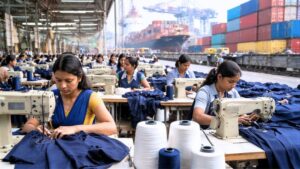
The company has established an education centre for women on the outskirts of Dhaka, daily run by the TCM Foundation. Almost 1,000 women have completed education programme from here to date, and as soon as they were able to start providing for themselves, not only their lives, but also the lives of their family members have changed.
Maximum sourcing from Bangladesh
It is interesting to know that the brand’s maximum sourcing is from Bangladesh, which is 44 per cent higher compared to that from China which is 35 per cent, while India contributes only 4 per cent. Overall it sources from 9 countries across the globe. The factories associated with the brand in China are, however, more than double compared to Bangladesh (see given below table). It is also pertinent to mention here that out of total sales of the company, kidswear has been the maximum at 47 per cent, while womenswear has been 45 per cent and menswear is just 8 per cent.
| Specification | India | Bangladesh | China |
| Share of production | 4 (4)% | 44 (45)% | 35 (35)% |
| Number of its employees | 14 (16) | 50 (51) | 64 (69) |
| No. of factories associated | 11 | 26 | 77 |
Truly ethical
COVID-19 has created very challenging situations for the company’s suppliers and its employees. When shops were temporarily closed by the authorities, declining customer spending meant reduced or cancelled orders for the workers in countries like Bangladesh, China and India.
KappAhl has, however, worked to co-operate as much as possible, finding constructive solutions that can help everyone. It did not cancel any orders that were ready, and has made payments as agreed.