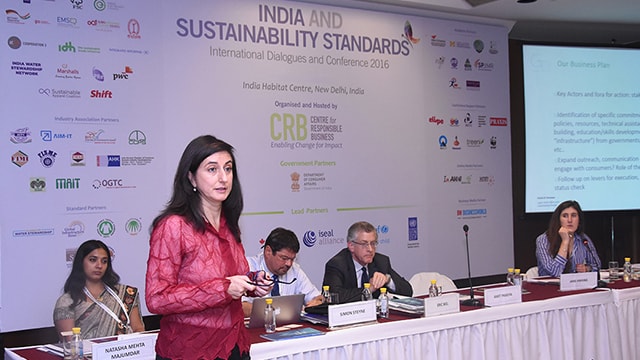
Covering all aspects of sustainability, especially with reference to India, Centre for Responsible Business (CRB) recently organized its 4th edition of ‘India and Sustainability Standard’ at Delhi. In this 3-day long international dialogue and conference, experts across various industries, foreign as well as Indian academicians and many stakeholders within the supply chain shared their views in thought-provoking discussions. They tried to come up with some suggestions and solutions for the current challenges. Focusing on the theme: ‘From the Tragedies of the Commons to the Strategies for the Commons’, this event also touched some of the difficult aspects being faced by the apparel industry.
The event witnessed exchange of strong views on fair prices and living wages, problems of women workers, piece-rates and living wages etc. In the session on living wages, the panel shared that two brands are already working on this concept with 2 factories (one each in Bangalore and Tirupur). But not all are convinced that this is the way forward and various stakeholders questioned whether the industry is actually paying minimum wages to its entire workforce. Simultaneously, concern was also raised on the already existing minimum wage which is difficult to pay for the industry considering the market conditions. Similarly, it was debated that since these wages are increasing almost every six months, how far will the exporters be able to afford such wages until and unless brands pay the difference of minimum wage and living wage, which according to some experts, is 2.5 times the minimum wage.
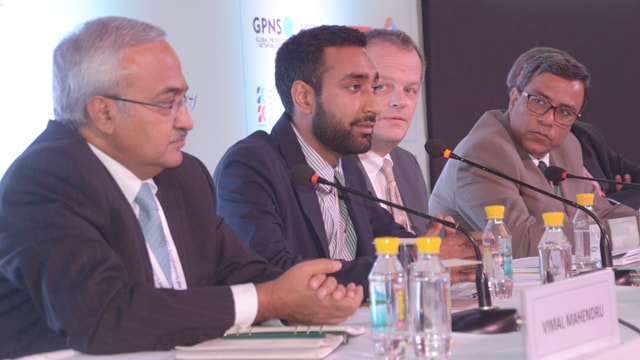
In the session dedicated to women empowerment, it was pointed out that among the numerous industries in India, the textile value chain is employing the maximum number of women, both at the factories and as home workers. However, it was emphasized that several women-related issues still remain to be addressed such as giving them equal rights as proclaimed in the constitution. It was admitted by all that the cultural thread in the country was one of the biggest reasons responsible for exploitation of women workers, followed by low education and lack of awareness of legal rights.
Young leadership at Shahi Exports is focused on Organizational Development
One of the most pertinent sessions was on ‘Leadership and vision in enabling pro-sustainability strategies and action’ in which the youngest and learned speaker Anant Ahuja, Director, Shahi Exports and Co- Founder & CEO, Good Business Lab shared his experience and views on sustainable aspects and also the above-mentioned issues in detail. Anant, who was motivated for ‘Organizational Development’ (OD) because of his education and personal interest, shared how he brought change in his organization through evaluation and action. Personal Advancement & Career Enhancement (PACE), a program on soft skills for the women workers by GAP and its evaluation, was the core subject of his discussion. Anant stated, “Looking at this business, sustainability for me meant how I can optimize the business for developing some sort of benefits. This was my initial reaction and I found that a lot of nice work, engagement initiatives and welfare activities were already there which we could scale up and take to all the workers. But by working with two different academicians, whom I had met earlier in my career, I realized that there is a better way to do business.” This better way involved focus on soft skills of workers, evaluation of programs, separate teams for evaluation and change in reporting for some cases.
Shahi hires mostly low-income women who are unskilled. Moreover, since most of the factories are in rural areas, women belong to the same community. So, Anant very quickly realized that the nature of business is closely tied to development. Shahi works with all top brands across the world and in recent years, these brands are moving beyond the compliance and looking for new ways to make social investment. Brands have been handling these positive interventions through their suppliers, but there is no evidence about whether these interventions are actually having much impact. Anant further briefed, “In this context, PACE program was nicely designed and this idea was brilliant, and they want to scale it up. But there was no concrete evidence about the effectiveness of this program; so a social impact evaluation was done. This evaluation showed that PACE was improving overall worker welfare in various ways. We explored how a program like PACE could sustain for so long. When I joined business, this program was already running and there were thousands of women into this program. It was clear that there were definitely some aspects of the program which were sustainable but we started to see the business impact of PACE, and how this program will help Shahi in its business. To test this business impact, we started Randomize Control Trial (RCT). The factories of Shahi, having this program, were compared to its units which were not having the same.” According to Anant, they were tested on many parameters like attendance, retention etc., and through results, Shahi was able to determine the business impact of this program. It was clearly noticed that the ROI in this program was above 250 per cent which proved that social investment relates to business impact as well.
“I notice CSR happening overall at 3 levels, specially in the context of the garment industry which is a low wage, labour-intensive industry. Hence, as per some people, the nature of our business is community development. In fact, a company approached us and as per CSR mandate, they wanted to give us some money just to run our factory. We were really confused about how this is business for us and CSR for them. Secondly, there is a sort of mandate which is actually community development outside one’s workplace for those who have little connect with one’s business, like supporting schools etc. Thirdly, what we want to push is one-step intersection, where there is social investment and growth of one’s own firm. This kind of investment is most beneficial for all and also more sustainable… – Anant Ahuja, Director, Shahi Exports and Co- Founder & CEO, Good Business Lab
This also motivated GAP to take this program beyond. When this result came out, it was easy for everyone from top to bottom at Shahi to know about the implementation of such programs. But this came with rigorous evaluation. Teams with good statistical abilities also helped in this. It is worth mentioning here that before this program, the export house was not so much focused on soft skills or the things related to personal development like effective ways to communicate, financial literacy etc., which are covered widely by PACE. The prior focus was only on technical training.
For this and allied exercises, Anant took 5 core people from the HR department and created a different team for Organizational Development (OD) and he feels that removing this small team from HR was like bypassing the system and expediting the reporting process, directly to the board, to take the issue up. This team as a separate identity started looking at labour issues in progressive ways. The same spirit was inculcated in other departments by this OD team to improve their efficiency. This was also a big change.
Anant shared that the need for separate teams was felt strongly as HR needs to do many transactional work. Due to 10 per cent attrition rate on monthly basis, HR took a long time to deal with such allied issues. In his words,“I feel that in lot of organizations, only the smell of roses rises to the top. Management gets to hear only the good news because people only want to talk about good thing, but with the OD team, we were able to see beyond what is being shown and find what is happening in the factory, and at the same time, we discussed in the board room that these are the pivotal problems, so we need to transcend the hierarchy in that way.”
Similarly, the company is noticing the business impact of energy saving. Shahi has changed its existing and conventional lighting system to LED and a major push for this initiative was by the buyers, specially guided by H&M. The payback time in this case was 3 years, but through evaluation, it was noticed that this change in lighting system not only helped in energy saving but also brought down the temperature of the factory by nearly 2.5ºC which created comfort for workers and resulted in productivity improvement. So, in a way, the payback period was revised from 3 years to 7 months.
Anant, therefore, suggests the small-and medium-level exporters to take benefit of the established and evaluated information to step forward in sustainability. He affirms,“Yes, it takes a lot of money to plan, execute and evaluate such programs, but once we know these are highly effective, all firms should look forward to invest in such programs because the cost that one is going to invest, will come back to him with big return. They should take established information and then build it into your system as well. You know that this is successful and backed up by evidence, so you can also implement them in your settings.”