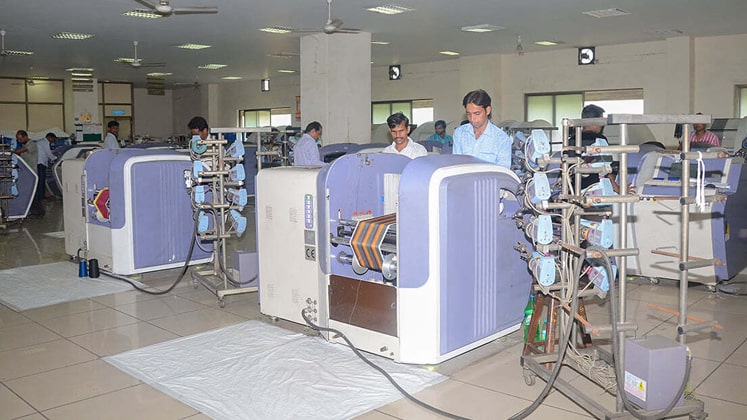
India’s largest single-roof state-of-the-art fabric processing facility BRFL Textiles Private Limited (BTPL) has introduced a new sulphur dyeing process by continuous dyeing method without requiring water.
BTPL is said to be the first Indian textile company to implement this new process of dyeing and to set a new sustainability standard.
According to the company, since inception, it has taken efforts to limit carbon emission and recycling of water through multiple ways. The current efficiency of the reverse osmosis unit at BTPL’s Tarapur plant facilitates the unit to reuse 50 per cent of the effluent water, enabling the plant to recycle up to 4 million litres of water per day.
The company is looking to further strengthen this efficiency and aims to increase the recycling level to 90 per cent in the next 3 months, enabling the plant to recycle up to 7.2 million litres of water per day.
Additionally, most of the reactive dyeing processed in the plant is undertaken with e-control process, thereby avoiding salt which in turn avoids increasing the TDS content of water.
BTPL also uses its energy co-generation design at its Tarapur plant, which enables it to reuse 48 tonnes of steam per hour, and save 250 tonnes of coal per day, leading to a significant reduction in carbon emissions that exceed even the sustainability benchmarks of global textile companies.
The company further added, “BTPL implements its sustainability measures across its products as well. A majority of the fabrics produced by BTPL, such as linen and cotton, are sold in its natural form, making it a part of the sustainability chain. Likewise, a large part of the linen and linen blended collection is produced by maintaining a natural fibre colour without adding any dye or colour to the fabric.”
Prashant Agrawal, Managing Director at BTPL, commented, “Today, greenhouse gas emission and scarcity of potable water represent a substantial sustainability challenge across the world. We are proud to combat both these areas through our state-of-the-art processes that set new sustainability benchmarks across the global textile industry and enable a more sustainable future for our vast global customer base. We are also hopeful that the Indian textile industry strengthens its focus on the need for sustainability in the sector and encourages and supports companies in the sector to innovate and adopt sustainable practices across operations.”





 Bharat Tex Special Report 2026