Despite the efforts of various stakeholders of the apparel industry, living wage is still far-fetched. And now the entire supply chain is under pressure than ever before due to COVID-19. So, will brands and retailers move forward in this direction? No, it’s almost next to impossible! On the basis of a recent report of Clean Clothes Campaign (CCC) ‘Out Of The Shadows: A Spotlight On Exploitation In The Fashion Industry’, it can be said that looking at the track record of top brands so far, there are no chances that in near future, the concept of living wages will be executed.
Campaigning and advocating for the improvement of working conditions in the apparel industry, the CCC is a global network of labour and human rights organisations, including unions. 108 brands and retailers (companies) from 14 countries were contacted by CCC for this research on living wages, undertaken in 2019 and early 2020 and 35 companies out of them didn’t share any response. While not even a single one of these brands paid living wages to their workers in their supply chain despite numerous pledges to do so. Not even with extensive overtime did workers achieve an amount corresponding to a living wage.
The companies were asked to provide evidence to show how many workers in their supply chains were being paid a living wage. Most were unable to show any evidence. Out of 108 companies, 100 were given an ‘E’ rating for their living wage results (on a scale from A to E) – meaning that in fact no living wages were paid to workers in their supply chain. Examples of these brands range from e-retailers like Missguided and Boohoo to high-street brands like adidas, H&M, Zara, Primark, M&S and Uniqlo.
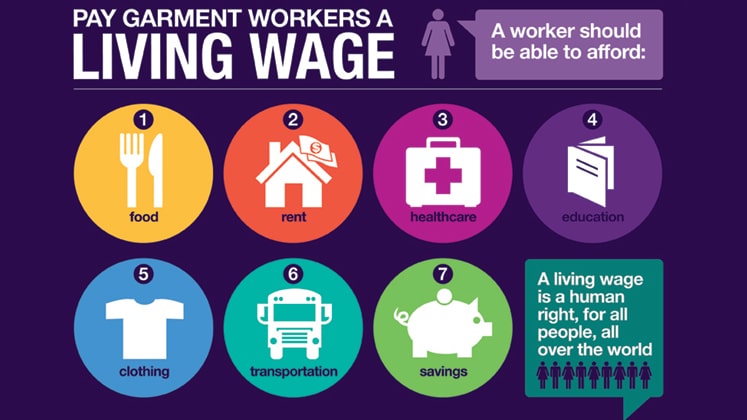
Living wage is a wage paid that is sufficient to meet the basic needs of a worker and his family and also provides some discretionary income. Across the globe, legal minimum wages in apparel manufacturing countries fall short of a living wage. The workers are unable to provide the most basic needs for themselves and their families. A living wage should be paid for work undertaken during a normal working week – no more than 48 hours.
The gap between the legal minimum wage and a living wage is ever growing. In Asia, the minimum wage can range from 21 per cent (Bangladesh) to about 46 per cent (China) of a living wage (research 2019).
Gucci was the only brand which received a ‘C’ rating. It stated that 50 per cent or more of its suppliers are paying the company’s stated living wages to all their workers; some plausible explanations were given in this regard but the evidence is not public. As per the company, 95 per cent of their manufacturers are Italy-based, and they pay a wage value negotiated in a national collective bargaining agreement with all the suppliers, but this wage only covers living wage in a limited number of cases.
Also Read: Labour shortage or not – A ground report by Apparel Resources
There were seven brands (Jack Wolfskin, Mayerline, Salewa, Schijvens, Stanley-Stella, Engelbert Strauss and Belconfect) which got a ‘D’ rating meaning that the brands have shown evidence that at least between 1 per cent to 25 per cent of their suppliers are paying the company’s stated living wages and that they have started contributing towards the payment of a living wage, including paying higher prices to all suppliers to cover higher labour costs, and the evidence is public.
Despite the fact that 63 brands in total have made some sort of public commitment, 79 have no actual public regarding improvement of wages for their workers across their supplier network. It’s worth mentioning here that only three brands – Belconfect, Kings of Indigo, Stanley-Stella – have published a time-bound, public action plan describing how they will achieve a living wage for workers in their supply chains.
On the other hand, Carrefour, B&C, Bel and Bo, BP, CKS, E5 Mode, Engelbert Strauss, JBC, Kuyichi, Mayerline, Van de Velde, Van Heurk say they have a commitment to pay living wage, but in fact, have no published time-bound plan for doing so.
A living wage differs from country to country and region to region within a country’s borders. In order to pay a living wage, it is necessary that a living wage is concretely defined – in each country and often in each region. Many brands have claimed to be committed to a living wage but have no benchmarks on which to base this goal upon. Benchmarks take living wages from an abstract concept to a deliverable goal. To do this, companies need to commit to benchmarks for a living wage based on the cost of living methodology in each of their sourcing countries or regions and use these figures (or ladders) to drive progress. A living wage benchmark must be in place in order to measure if wages paid in the supply chain are enough to meet a worker and his/her family’s basic needs. There are a number of living wage benchmarks available, based on differing methodologies.
“Out of the 108 brands surveyed, only 28 have published a clear commitment to ensure living wage is paid across their supplier network. There are some commitments by an additional further 35 brands but in these instances, the brand’s definition does not meet all the criteria for a living wage (for example it does not cover a family). However, no commitment was found to ensure a living wage is paid across the supplier network of 46 brands. These brands include Amazon, Aldi and Lidl as well as Puma and Levi’s and a host of smaller brands,” the report read.
The report also mentioned about a worker’s survey and claimed that the field research observed that none of the workers surveyed were earning a living wage. Indeed, 27 per cent of surveyed workers were paid below regional or national statutory minimum wage level without working overtime.
Some of the above-mentioned brands are leading players across the globe and claim a lot of good and impressive things in their sustainability, CSR reports. Until and unless such brands will not be 100 per cent committed towards living wages, it is very difficult to expect thousands of other brands to move positively ahead in this direction.
| Place | Net 2019 minimum wage in local currency | Living Wage (Monthly) |
Benchmark | Net Wage range (monthly) | Average net without overtime |
| Tamil Nadu | 339 per day – 8475 based on a 25-day working month | 29,323 | Asia Floor Wage Alliance (AFWA) |
6351 – 9200 | 8208.94 |
The table states the difference between what the workers were being paid, the estimated living wage (according to credible benchmarks relevant to each location) and the legal minimum wage.
Also Read: All you must know about labour reforms






 Bharat Tex Special Report 2026