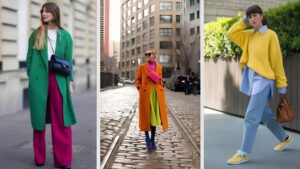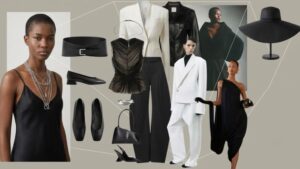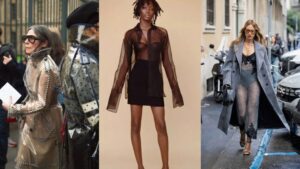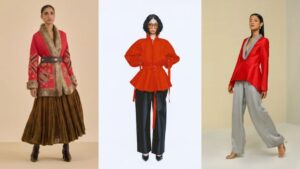
Funnel necks, peplums and cocoon shapes are turning proportion into the main design idea of the winter wardrobe, across casual, formal and outerwear.
Streamlined silhouettes have not gone anywhere, but this winter’s more interesting dressing comes from playing with proportion. Global labels including Balenciaga, Khaite, Ashlyn and Stella McCartney (Resort 2027) have pushed exaggerated shapes. They include billowing funnel-neck jackets, peplum dresses and cocoon-shaped trousers. Contemporary labels such as Self-Portrait (rib-knit peplum midi), A.L.C. (pleated cotton-blend jacket) and Simkhai (parachute pants) have translated the same idea into wearable pieces. The common thread is that extra volume gives even a simple outfit some whimsy.
The trend has also shown up on the Indian runway. At Lakmé Fashion Week 2026, flowing dresses and gowns with sculptural construction and dramatic proportions dominated the runways, with the bubble or balloon silhouette emerging as one of the season’s most striking shapes. The volume language is not new to Indian wardrobes either. Puff and balloon sleeves have been a consistent blouse trend in Indian ethnic wear over the past two years, which gives designers a ready hook for this season’s global conversation.
Eveningwear and occasionwear are where Indian designers have taken the idea furthest. Rahul Mishra’s A/W 2026-27 couture collection, Devi: The Eternal Muse, drew on 2,000-year-old temple sculpture and featured sculptural silhouettes alongside hand embroidery. The lineup included exaggerated sculptural frames, oversized collars and dramatically carved shoulder plates. He later closed India Couture Week with the same collection.
Mishra is not alone in treating the body as architecture. Gaurav Gupta’s sculptural draping and Rimzim Dadu’s metal-and-cord bodice work have built similar vocabularies in recent India Couture Week showings, while Amit Aggarwal’s moulded, technical silhouettes have long explored the same territory. Gupta’s S/S 2026 couture collection used jasmine blooms as structural material in sculpted bridal gowns and sari silhouettes. At Lakmé Fashion Week, Aggarwal used vintage Benarasi to build a structured evening line.
Anamika Khanna works across both ends of the spectrum. At India Couture Week she added sculptural peplum detailing, the same silhouette now running through global dress shelves. At Lakmé Fashion Week, her AK|OK label showed fluid dresses with a deliberately unfinished feel, alongside structured blazers and coats embellished with delicate motifs. Elsewhere on the formal front, Richa Khemka’s VESPER collection at Lakmé Fashion Week combined sculptural silhouettes, sheer organza and metallic accents. Aisha Rao explored bold shapes in statement eveningwear. Rohit Gandhi + Rahul Khanna have spoken of their long-standing interest in architectural elements in couture.
Raw Mango took the idea to London. At its F/W 2026 debut at London Fashion Week, an oversized garland became a sculptural garment, blurring the line between adornment and clothing.
The shift this season is that sculptural thinking has moved from the gown to the wardrobe staple. Lakmé Fashion Week 2026 marked a move away from occasionwear and toward clothes designed to be lived in.
In ready-to-wear, Abraham & Thakore showed clean, architectural separates, Payal Pratap worked structured tailoring, and Ritika Mirchandani explored structured silhouettes with precise construction. Vaishali S’s debut ready-to-wear line carries over a signature cording technique that appears as sculptural yet soft detailing tracing the silhouette. In menswear, Dhruv Vaish leaned into structured forms. Countrymade’s A/W 2026 collection, Foundry, treated fabrics like metal, boiling, fusing and manipulating them to hold tension and strength. That is a more material-led route to the same sculptural result.
Streetwear labels are contributing the relaxed end of the volume spectrum. Huemn is known for gently oversized jackets and sweatshirts.
Outerwear is where proportion does the most work, and international houses have set the tone. Louis Vuitton’s A/W 2026 show featured voluminous coats, exaggerated shoulders and cocoon-like caped silhouettes. Indian designers are working with the same vocabulary, especially in the jacket and cape categories that sit between occasion and daywear.
The cocktail blazer is the clearest example. At India Couture Week it showed up across cropped, soft and structured knee-length versions. Brands named in coverage include Jayanti Reddy (a zardozi jacket over a cocktail saree), Arpita Mehta (mirror-worked blazers), Falguni Shane Peacock (a metallic knee-length blazer) and JJ Valaya (a bloom-embroidered blazer). Below the couture tier, labels such as Masaba (Heavy Crepe Blazer Set), Kanika Goyal (Gleam Fold Blazer Set), Soup by Sougat Paul (Black Velvet Appliqué Embroidered Blazer Set) and Torqadorn (Slate Grey Embroidered Blazer) offer structured versions, with Power Sutra, FableStreet and Tahvo & Elle also in the mix.
Capes are another route to volume. Retailer listings show Pankaj & Nidhi with hand-embellished capes, kalidar jackets and saree cape sets, and Nikita Mhaisalkar with a draped midi dress and cape set.
The opportunity is practical as well as aesthetic. Indian winters are short and transitional, so sculptural outerwear does not have to mean a heavy wool coat. Indian labels building contemporary outerwear, from bomber and utility jackets to structured coats, are well placed to absorb the new proportions. A statement jacket, a peplum layer or a cocoon-shaped trouser lets a brand add drama without changing the base wardrobe.