Apart from the residents of the region, the textile and apparel industry of Delhi-NCR has also suffered majorly owing to the prevailing smog which has been continuing for more than a week. Some of the disaster control measures taken by the Government and orders of the Supreme Court, made to regulate the situation, also have had an adverse impact on the working of the industry. In the meanwhile, some of the apparel exporters have taken active steps to tackle the alarming situation, but there is strong anger among the community because everyone, especially the Government, expects the industry to follow all the environment laws and imposes fine on them if not followed, but the same Government has done practically nothing to prevent the situation on a larger platform, though it has become an annual problem.
Talking to Apparel Resources, few exporters confirmed that their raw material has been delayed due to the decision of the State Government to ban entry of trucks into Delhi. Some of the other exporters shared that the rate of absenteeism has increased in their factories affecting their work functioning. “For sure, it is a disaster. It is the responsibility of the Government to assure clean air and regulate, remove or reduce the use of such products/chemicals that cause harmful toxins to be formulated in our air, water and other resources. We, as business owners, need to provide every means possible to protect our staff, reduce waste and pollution to an absolute minimum and have a green impact on the ecology. We are realizing that we need to set an example in this, but the Government has to be proactive and not reactionary,” said Cornelia Bosman, Director, Open Hand. Other Delhi-based companies are equal victims of the increased pollution levels and allied reasons.
On the one hand, while the Supreme Court has banned the use of pet coke and furnace oil in an effort to clean up toxic air, on the other, it has created issues at process houses, dyeing mills etc., further affecting the garment exporters. Sunil Mehra, Director, Campari Export Gurgaon informed, “As some of the mills with whom we were working have stopped production, this has resulted in orders’ delay. To tackle with this situation, we are approaching different mills outside of Delhi-NCR and also exploring imported fabric options. Some exporters have complained about the very high and unjustified rates that these process houses are charging in the name of increased cost.” One of the leading home furnishing exporter Mahajan Overseas, having a unit in the industrial area of Sonepat, is badly affected by the situation. Pranab Mahajan, Director of the company stated, “The GT road, which is used by our staff to travel every day, is in a complete mess as the trucks have stopped and logistics have come to a standstill… We really have no clarity on what is happening…”
“The decision of the Supreme Court will highly impact the businesses of exporters, manufacturers and textile units. This is the peak season, and the sudden announcement by the Court has left the exporters with no other option but the closing down of the units. We, as an exporters, have only fabrics for the next few days of production and now it will be difficult to procure fabrics that will lead to delay of production.” – HKL Magu, Vice Chairman, AEPC and MD, Jyoti Apparels, Delhi
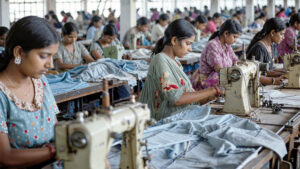
Many exporters have distributed masks to their workers and are rigorously guiding them about how to remain safe under such circumstances. The exercise of pouring water in the periphery area is continuously going on so that moisture can be increased. Jaggery is also being distributed to the operators; and some of the factories have kept handful of camphor in corners too to make breathing easy. “We have taken all steps to keep our staff safe, yet on specific days when air is really bad, absenteeism increases from nearly 17 to 22 per cent which is very high compared to normal days,” says Pawan Arya, VP, Orient Crafts, Noida.
There are exporters who have allowed their women workers (experts of handwork) to work from home for a week and have made arrangements for the dispatch and delivery of goods in a way that can have a minimal effect on the environment. Nupur, Director, Accessories by Nupur, Noida informed, “We asked 12 women workers doing handwork to operate from home for one week and arranged a person who coordinated with them for smooth work flow.” She further informed that earlier, every year they used to distribute crackers to the workers on Diwali, but this year crackers were replaced with other gift items.
Mahajan Overseas also conducts awareness sessions with workers to motivate them regarding the environment. To discourage the use of plastic, the company distributed nearly 1,000 fabrics bags. So far, the industry has been somehow able to manage with all these situations but it is a confirmed fact that if the same situation continues, it will definitely have more serious impact.





 Bharat Tex Special Report 2026