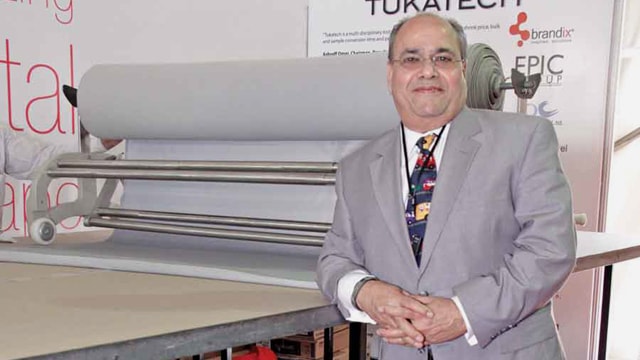
One of the most fundamental theorems for the success of an apparel manufacturer in the global economy is that greater the number of styles handled by the company, the better is the profitability. But how does a company multiply the products developed by it when the very core of this process, the aspect of pattern making, is being managed in an archaic manner using brown paper and measurement tapes. This sole idea has put the American-pioneer Tukatech in a position envied by many, explains Ram Sareen, Head-Coach & Founder Tukatech Inc. “Here’s a simple example: 5 years ago a company was manufacturing 1 million garments per month with an FOB of US $ 5 per piece and earning US $ 5 million as the gross revenue. But now when the FOB has reduced to US $ 4, they have to make an additional 2,50,000 garments per month to have the same revenue of US $ 5 million per month. To add insult to injury, the quantity per style is now reduced, thus adding more style to produce the same revenue. But how do you expedite the product development with a pattern master who can produce just 2 patterns per day manually on paper? You cannot just keep adding more pattern makers, sample makers with same old process as you don’t get paid for Product Development yet you cannot be in the business without development of style and sample.
The company which started as a pattern and marker making software provider, has now expanded its supremacy to make available solutions for product development and cutting room operations. “The point is not that a software can make 3 to 4 times more patterns than paper patterns, but with the integration of all these solutions ranging from body scanning, pattern making, 3D visualization to marker making, the lead time for product development has been reduced to days, hours and in some cases to minutes… which is what we have highlighted at this conclave,” asserts Ram Sareen.
A client list with names like Brandix, Hirdaramani, MUST, Epic, Timex, Palmal, Creative Group, Goldenseam Textiles, Orient Craft, Gokaldas Images and many more all over the world, Tukatech has also worked intensively with international buyers like Kohl’s, JCPenney, Target and Chico’s, in building better solutions and blocks because of having a strong foundation built on the understanding the concepts of fit, speed to market and requirement of the end customer. “The brands that have become successful in today’s times are the ones who have understood the concept of mass customization focused on the age, requirements, purchasing power, body shape and fit measurements of their target customers, because the fit of the garment is still the primary factor which defines the ultimate sale,” opines Ram Sareen.
The standard procedure for defining the fit of a garment starts by recognizing the measurements and shape of the human body of a certain size, which is then used to develop rest of the sizes via the process of grading, under which increments or deductions of pre-defined inches or centimetres are made in patterns of consecutive sizes to prepare a complete size set. “The inexplicable manner in which companies do grading does not take into consideration the body shapes of the end customers because a person doesn’t grow in such a tangible and symmetric manner. The fact that 85% of the people are not happy with the fit of the garments they wear, which supports this phenomena (15% is the sample size and most brands work very hard to make THAT size perfect),” elaborates Ram Sareen. Having understood Tukatech’s thought-process, many brands and retailers have developed their basic slopers (patterns) for all the sizes with them and then define the specific size-to-size grading ratios for future applications.
Discussing their work on the same lines with the Indian ethnic brand ‘W’ for Women, Ram Sareen says, “We asked the company to define 6 fit models for the 6 different sizes they manufacture, to whom each size would fit perfectly. After that we got them body scanned, made the basic slopers and defined the size-wise grading ratios, which resulted in the company making perfect fit kurtas and churidars, which are usually far from fitting.” The company claims to have eliminated the archaic process of grading by focusing on mass customization and once the size library is complete only the fabric specifications and specific measurements have to be altered in the software to make a complete new pattern. “With its seamless integration of knowledge and the software solutions, the potential is immense and the companies do not need to rely on the whims and fancies of pattern masters,” adds Ram Sareen. Tukatech claims that the Sri Lankan high-fashion womenswear brand Avirate having adopted the company’s solution for its product development, are making 800 styles per month.
To bridge the gap between the ability of their solutions and the practical application, Tukatech has developed a strong foundation in terms of training and development of pattern makers by setting up training institutes both in India and abroad. “The people trained by us have such in-depth knowledge of the subject that they can compete with a pattern master of any company but at one-fourth of their salary and making better quality patterns that FIT,” avers Ram Sareen. Tukatech has not only established its own training centres, but over 500 colleges all over the World.
TUKAcad 2D and 3D systems. have helped industry a lot as they get better trained personnel to fulfil the demand for development of fast fashion, fast. “The other side of this has been companies buying our solutions just because their pattern makers have been trained by us and is well-acquainted with the software,” explains Ram Sareen, and claims of having trained more than 1,500 pattern makers in Sri Lanka alone. Taking this initiative forward, Tukatech has been conducting a contest wherein TUKAcad operators from all over the world send in their shortcuts and tips for using the solutions in a much more efficient manner, who are then awarded US $ 100, US $ 500 and US $ 5,000 on a weekly, monthly and annual basis, respectively. “It is not only about encouraging the people to use the systems efficiently but also about sharing the best practices of a few good companies with everyone, to learn from,” concludes Ram Sareen, who believes that the recent success found by the company has been due to these initiatives only.